The Non-fiction Feature
Also in Bulletin #54:
The Fiction Spot: Firekeeper’s Daughter by Angeline Boulley
The Product Spot: National Museum of the American Indian
The Pithy Take & Who Benefits
Journalist David Grann explores one of the most alarming conspiracies in U.S. history: the coordinated murders of the Osage Indians who, in the 1920s, were the richest people per capita in the world after oil was discovered on their land. Their numbers slowly dwindled as they were getting murdered–shot and poisoned–and the headrights slowly began funneling to Osage tribe member Mollie Burkhart.
I think this book is for people who seek to understand:
(1) how the deaths unfolded, including those that were categorized as homicides and those that were unresolved;
(2) the structure of society during that time, particularly white guardianship over Osage Indians that restricted how they could spend their money, and how this framework contributed to covering up murders; and
(3) the formation of the FBI, which was tasked with unraveling the Osage murders.
The Outline
The preliminaries
- In 1803, President Thomas Jefferson purchased the Territory of Louisiana from the French, which contained lands dominated by the Osage Nation, a Native American tribe.
- Over the next few decades, the U.S. government forced the Osage to cede nearly a hundred million acres, and after impatient settlers massacred several Osage in the 1870s, they searched for a new homeland.
- In the early 20th century, the U.S. government planned to break up territory they had settled on in Oklahoma, and for months tribe members and government officials negotiated.
- The Osage convinced the government to divide the land solely among members of the tribe, and the agreement included the following provision: “That the oil, gas, coal, or other minerals covered by the lands…are hereby reserved to the Osage Tribe.”
- So, those on the Osage tribal roll each received a headright–a share in the tribe’s mineral trust.
- In 1917, oil was discovered on those lands. To get that oil, prospectors had to pay the Osage for leases and royalties.
- Over the years, the tribe members had collectively accumulated millions. In 1923 alone, the tribe took in more than $30 million, the equivalent today of more than $400 million.
- The Osage were considered the wealthiest people per capita in the world.
- But, the U.S. government, contending that many Osage couldn’t handle their money, required the Office of Indian Affairs to determine which members of the tribe it considered capable of managing their trust funds.
The Murders of Anna Brown and Charles Whitehorn
- On May 24, 1921, Mollie Burkhart, a resident of the Osage settlement town Gray Horse, began to fear that something had happened to one of her three sisters, Anna Brown, who had disappeared three days earlier.
- Like their parents, Mollie and her sisters were members of the tribe, and they possessed a fortune.
- Gray Horse was one of the reservation’s older settlements. The streets were full of fortune seekers, New York financiers, and oil magnates. Automobiles sped along paved horse trails, and there were restaurants, opera houses, and polo grounds.
- Mollie was one of the last people to see Anna before she vanished. Mollie’s husband was Ernest Burkart, a 28yo white man, and they had children; Mollie also took care of her aging mother, Lizzie.
- In 1912, when he was 19, Burkhart moved from Texas to Osage territory, joining his uncle, William K. Hale, a domineering cattleman.
- News of Anna’s disappearance raged throughout town, and fueling the unease were reports that another Osage, Charles Whitehorn, had disappeared as well.
- Soon after, both Anna and Charles were found–Charles, out by the oil rigs, had been shot between the eyes, and Anna, down by a creek, had been shot in the back of her head.
- The justice of the peace picked the jurors from among the white men at the ravine.
- They were charged with determining whether Anna had died by an act of God or man, and if it had been a felony, then they were tasked with trying to identify the principals and the accessories to the crime.
- The Shoun doctors (David and James Shoun) examined her and determined that she had been shot–the path of the bullet had entered just below the crown, on a downward trajectory.
King of the Osage Hills
- These killings caused a sensation. Mollie pressed the authorities to investigate her murder, but most seemed to have little concern for what they deemed a “dead Injun.”
- So, Mollie turned to Burkhart’s uncle, William Hale.
- His business interests dominated the county. He owned around 45,000 acres of the best grazing land in the county, and a small fortune.
- Many considered him Osage County’s greatest benefactor, as he aided the Osage before they were flush with oil money, and donated to charities and schools and a hospital.
- So, Mollie turned to Burkhart’s uncle, William Hale.
- William Hale vowed to obtain justice for Anna.
- Bryan Burkhart, William’s nephew and Ernest’s brother, was last seen with Anna.
- But, there was no evidence implicating him.
- By July 1921, the justice of the peace closed his inquiries, finding that Charles and Anna’s deaths had come at the hands of unknown parties.
- Soon after this, Mollie’s mother, Lizzie, passed away.
- Mollie’s brother-in-law, Bill Smith, wondered if there was something curious about Lizzie’s death, as it came so soon after the murders of Anna and Charles–he thought she was poisoned.
Reign of Terror
- During this time, more Osage continued to die of suspected poisoning.
- In August of 1922, many Osage asked Barney McBride, a wealthy white oilman, to go to D.C. to ask federal authorities to investigate.
- He went, but when he arrived in D.C., he disappeared and was found the next morning stabbed more than twenty times. Authorities suspected that his killers had followed him from Oklahoma.
- The number of murders continued to climb, and in 1923, someone bombed the home of Mollie’s sister (Rita) and brother-in-law (Bill Smith), killing them both.
- The bombing was horrific and terrified the community.
- Later that year, W.W. Vaughn, an attorney, tried to help to solve the murders.
- One day, he received an urgent call from someone who was a friend of George Bigheart, who was a nephew of the legendary chief James Bigheart. He said that he had information about the Osage murders but would only speak to Vaughn.
- Vaughn went to visit him in the hospital, where Bigheart shared his information and handed Vaughn incriminating documents.
- Vaughan called the Osage county sheriff, and told the sheriff that he had all the information he needed and that he knew who the killer was, and that he was heading back.
- But when the train arrived, there was no sign of him. Two days later, his body was found by the railroad tracks, dead, and the documents were gone.
- At this point, the official death toll of the Osage Reign of Terror was at least 24 members of the tribe. The world’s richest people per capita were becoming the world’s most murdered.
The newly emerging FBI
- President Theodore Roosevelt created the Federal Bureau of Investigation in 1908, hoping to fill the void in federal law enforcement.
- In 1925, Tom White, a special agent who was in charge of the FBI’s field office in Houston, received an urgent order from the new head of the FBI, J. Edgar Hoover.
- Hoover rapidly reshaped the FBI into a monolithic force–one that, during his nearly five-decade reign as director, he would deploy not only to combat crime but also to commit egregious abuses of power.
- When Hoover met White, his grip on power was tenuous.
- Hoover needed White–one of his few experienced agents–to solve the Osage murders and protect Hoover’s job.
- So, White set out for Oklahoma City to command the field office there.
- Repeat killers tend to rigidly adhere to a routine, yet the Osage murders were carried out in a bewildering array of methods.
- That meant that whoever was behind all the murders likely employed others to do his dirty work.
- White realized that the greatest problem with the earlier investigations was not that agents had failed to uncover any leads, but that there were too many leads.
- White put together a team of undercover agents, which included a former sheriff and a onetime spy for the revolutionary leaders in Mexico.
The FBI investigation
- Anna Brown’s murder
- Virtually no evidence had been preserved from the various crime scenes, but as for Anna Brown, the undertaker had secretly kept her skull.
- When White examined it, he realized that there was no exit wound, which meant that the bullet should have been inside the skull, and impossible to miss during the autopsy.
- But, it wasn’t there. So, someone must have taken it.
- Was it possible that one of the Shoun brothers took it?
- When White examined it, he realized that there was no exit wound, which meant that the bullet should have been inside the skull, and impossible to miss during the autopsy.
- Rose Osage
- During their investigation, a person told White that a woman named Rose Osage confessed to her that Anna was in the car, and Rose shot her.
- But when agents interrogated that person, she admitted that Rose never told her any such story. In fact, the person said that a white man had come to her house, wrote the statement framing Rose, and forced her to sign it.
- Virtually no evidence had been preserved from the various crime scenes, but as for Anna Brown, the undertaker had secretly kept her skull.
- White realized that the conspirators were not only erasing evidence–they were manufacturing it.
- Eventually, White discovered a crack in Bryan Burkhart’s alibi regarding Anna’s death: although he did take her home, he eventually went back out with her. Also, White found witnesses who said that a third man was with Bryan and Anna late that night.
- Soon, White discovered that there was a mole within their investigation: a private eye they had worked with called Pike, whom William Hale had hired back in 1921 to solve the murders.
- White discovered that Pike had actually withheld the fact that he knew the identity of the third man spotted with Bryan and Anna.
- During interrogation, Pike revealed that Hale actually hired him to conceal Bryan’s whereabouts on the night of Anna’s murder. Specifically, he was supposed to manufacture evidence and generate false witnesses.
- And when Hale gave him these instructions, Bryan and Ernest Burkhart were present as well.
- The FBI questioned Bill Smith’s lawyer, who had previously insisted that he had no idea who blew up the Smiths’ house.
- After more interrogation, he revealed that in the hospital, Bill Smith had said that the only two enemies he had in the world were William K. Hale and Ernest Burkhart.
- And the more White investigated the flow of oil money from Osage headrights, the more corruption he found.
- Although a handful of white guardians and administrators tried to act in the best interests of the tribe, countless others used the system to swindle the very people they were ostensibly protecting.
- Some guardians would turn all of their wards’ business to certain stores and banks in return for kickbacks, or they would just steal.
- White discovered that this was an elaborate criminal operation.
- The crooked guardians and administrators were typically among the most prominent white citizens: businessmen and ranchers and lawyers and politicians, and so were the prosecutors and judges who facilitated and concealed the swindling.
- For example, there was a case of a widow whose guardian had stolen most of her things.
- The guardian lied to her and said that she had no more money, leaving her to raise her two young children in poverty.
- When the widow’s baby got sick, the guardian refused to do anything, and the baby died. The evidence of the fraud was brought before a judge, only to be ignored.
- There was also the death of Henry Roan, another member of the tribe. White discovered that Hale was somehow the beneficiary of Roan’s $25,000 life-insurance policy.
- White spoke with the insurance salesman, who said that Hale had pushed for the policy. White examined the insurance documents, and he realized that Hale and forged some of the documents.
- He then discovered that before Hale got the policy, he had tried to purchase Roan’s headright.
- One way to do this was through inheritance.
- As White examined the probate records of the murder victims, it became apparent that with each death, more and more headrights were being directed to Mollie Burkhart, who was married to Hale’s nephew Ernest, who was controlled by Hale.
The quick-draw artists, the yegg, and the soup man
- As White picked up more and more clues about people Hale and presumably hired for murder, he realized that anyone who could implicate him was being eliminated.
- White was also very concerned about Mollie Burkhart. Although he had received reports that she was sick with diabetes, he was suspicious.
- Her diabetes seemed to have provided an opportunity for bad actors to deliver poison.
- Some of the town’s doctors, including the Shoun brothers, had been giving her injections of what was supposed to be insulin, but she kept getting worse.
- Her diabetes seemed to have provided an opportunity for bad actors to deliver poison.
- After a series of interrogations and confessions, White had enough to issue a warrant for Ernest Burkhart.
- After a long while, Burkhart spoke about William Hale.
- Burkhart worshipped him as a boy, and at one point, his uncle had shared his plan plan to kill Rita and Bill. Burkhart said that he protested, and Hale assured him that as a result, Mollie would get all the money.
- Hale sought out multiple people to kill Rita and Bill.
- Burkhart also provided crucial details about how Hale had arranged the murder of Roan for the insurance money.
- As for Anna’s death, Burkhart revealed the mysterious third man who had been with her shortly before her death: Kelsie Morrison, the undercover informant who had supposedly been working with the agents to identify the third man. Ernest said that it was Morrison who shot Anna.
- After a long while, Burkhart spoke about William Hale.
- At this point, White wasn’t able to connect Hale to all 24 Osage murders, or to the deaths of the attorney Vaughan and the oilman McBride.
- But, he soon learned that Hale and Bigheart were seen together soon before Bigheart was rushed to the hospital. And, after Bigheart’s death, Hale made a claim upon Bigheart’s estate, by presenting a forged creditor’s note.
- The trial came with its own significant challenges and setbacks.
- Additionally, White knew that the judicial institutions, like policing agencies, were permeated with corruption.
- Before and during the trial, crooked private eyes began trailing witnesses, even trying to make them disappear.
- Burkhart eventually confessed that he hired a man to blow up the home of Rita and Bill, and said that Hale led the plot. In 1926, Burkhart was sentenced to life imprisonment.
- After that, the trial for Hale and Ramsey began, for the murder of Henry Roan.
- There was one question that neither the judge nor the attorneys asked the jurors but that was central to the proceedings: Would a jury of twelve white men ever punish another white man for killing an American Indian?
- Ernest Burkhart testified that Hale ordered Roan be shot.
- White was stunned that the jury could not come to a decision. The jury was also hung when Bryan Burkhart was tried for Anna Brown’s murder.
- It seemed impossible to find twelve white men who would convict one of their own.
- Ultimately, months later, the jury found Ramsey and Hale guilty of first-degree murder, punished with life imprisonment.
- Hale never admitted to ordering any of the murders. As for Mollie, she began again to socialize and attend church, and eventually married a man named John Cobb. And finally, in 1931, a court found that Mollie was no longer a ward of the state, and she could finally spend her money as she wanted; and, she was recognized as a full-fledged American citizen.
The reporter
- As horrifying as Hale’s acts were, there was another layer to this case–beyond what the FBI investigation revealed.
- In 2012, the author visited Pawhuska, hoping to find information on the Osage murders. He stumbled upon a reference to the murders and has been trying to resolve lingering questions, to fill in the gaps in the FBI’s investigation.
- For instance, he spoke with the daughter of Mollie’s son. He found out that the night that Rita and Bill’s home blew up, he and Mollie and his sister had been planning to spend the night, but didn’t because he had a bad earache. He had to live knowing that his father had tried to kill him.
- The author realized that the FBI did not connect Hale to all 24 murders.
- Additionally, multiple American Indians were killed during this time, but the deaths seemed “natural” and so were not included in the final tally of the Osage murders.
- As an example, the author came across a manuscripted titled, “The Murder of Mary DeNoya-Bellieu-Lewis.” She was a member of the tribe.
- In her fifties, Lewis took her daughter to a trip in Texas, and was accompanied by two white men. A few days later, she vanished.
- The authorities did nothing, so her family hired a private detective, who discovered that after Lewis’s disappearance, one of the white men with her pretended to be her adopted son in order to cash several of her checks.
- Afterwards, the other white man confessed to beating Lewis over the head with a hammer. They planned to use a female associate to impersonate her so that they could collect the headright payments.
- As an example, the author came across a manuscripted titled, “The Murder of Mary DeNoya-Bellieu-Lewis.” She was a member of the tribe.
- Lewis was murdered in 1918, and according to most historical accounts, the Osage Reign of Terror spanned from 1921 to 1926.
- So Lewis’s murder meant that the killings over headrights had begun at least three years earlier than was assumed, and per some accounts, continued several years after.
- These cases underscored that the murders of the Osage for money were not the result of Hale’s schemes, though he led the longest killing spree. There were countless others that were never investigated or even classified as homicides.
- Scholars and investigators who have since looked into the murders believe that the Osage death toll was in the dozens, if not the hundreds–virtually every element of society was complicit in this system.
And More, Including:
- Oil barons and their massive political power
- Multiple attempts by multiple types of law enforcement to investigate the murders, and failing (and being bribed)
- Significant details about the creation of the FBI and about the FBI’s investigation, as well as the ups-and-downs of trial–of the Osage murders
- The author’s own investigation, which uncovered unresolved murders and more potential suspects
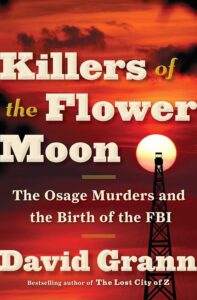
Killers of the Flower Moon
Author: David Grann
Publisher: Vintage
416 pages | 2018
Purchase
[If you purchase anything from Bookshop via this link, I get a small percentage at no cost to you.]