The Non-fiction Feature
Also in Bulletin #48:
The Fiction Spot: The Rock Eaters by Brenda Peynado
The Product Spot: NAACP student debt stories
The Pithy Take & Who Benefits
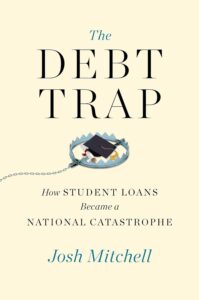
Josh Mitchell, a reporter at the Wall Street Journal, presents a clear-eyed retelling of the U.S. student loan program, and how it became the monster that it is today. He spent over a decade reporting on this issue, and conducting hundreds of interviews with borrowers, legislators, lobbyists, college presidents, Wall Street investors, and interviews with the first four CEOs of Sallie Mae. He reveals how much trust people put into institutions–banks, schools, and the government–and how greed tarnished good intentions. He also spotlights the evolution of the struggle between wanting to provide everyone an opportunity for higher education, and the need to pay for it.
I think this book is for people who seek to understand:
(1) how the student loan program began;
(2) how banks, universities, Sallie Mae, and the federal government transformed it over the decades; and
(3) how it has damaged and shaken the lives of millions of students and their families.
The Outline
The preliminaries
- As of 2021, 43 million people owe $1.6 trillion in student debt.
- The program started with good intentions–elected officials wanted to give everyone the chance of upward mobility by removing the financial barrier to college.
- They did so by providing loans.
- Families put their faith in institutions–the government, banks, and universities–when they signed up for loans, thinking that these institutions had their best interests at heart.
- But the student debt structure that these institutions created enabled schools to raise tuition faster than family incomes rose.
The Visionary (1957-1969)
- In 1957, the Soviet Union had launched Sputnik, humanity’s first artificial satellite, and fears grew that they were going to send a nuclear bomb to the U.S.
- Lyndon Johnson was senate majority leader at the time, and in face of this threat, he concluded that the country needed more college graduates.
- Few people went to college because of how expensive it was, universities said they didn’t have enough money, and employers couldn’t find good workers.
- Given this backdrop, leaders from both parties worried about the same question: Should college be free, paid by taxpayer-funded scholarships, or should households bear at least some of the cost, through student loans?
- Ultimately, eleven months after Sputnik, Congress entered the student loan business, which required students to pay a substantial portion of tuition.
- Even though it funneled hundreds of millions to schools, because Congress approved only a finite amount of money for the program, many were rejected, and colleges sought to expand the program.
- Lyndon Johnson became president in 1963; he was a former schoolteacher, and saw education as the most effective way to reduce poverty.
- He steered the program to banks, in the hopes that schools, banks, the government, and students would all participate somewhat equally in this process.
- Ultimately, Congress passed the Higher Education Act, otherwise known as the bankers’ bill (heavily lobbied by the American Bankers Association).
- This included a scholarship program for the poor and the Guaranteed Student Loan Program (GSLP) for the middle-class.
- Under GSLP, a student could borrow up to $1k a year for college, or $1.5k a year for graduate school.
- GSLP provided tens of millions to non-profit guarantee agencies to insure student loans–the guarantee agency would co-sign the loan.
- If the student couldn’t pay and defaulted, the guarantee agency would fully reimburse the lender for the principal (main amount owed) and the accrued interest.
- Then, the government reimbursed the agency for 80% of the principal.
- Congress set a 6% interest rate on the loans–the government paid that rate to banks while students were in school and for a brief period after graduation.
- But inflation hit, and the 6% interest rate was not enough to cover the banks’ costs, so many banks refused to participate. At the same time, colleges were raising tuition.
- So, banks, colleges, and students needed more money.
When Ed Met Sallie (1969-1990)
- Ed Fox–who managed investments for Mobil Oil–stepped in to address this money problem, and was instrumental in transforming the student loan industry into a monster.
- Banks needed more money for student loans, and Fox had to find that money.
- Usually, to raise cash, banks make student loans and sell them to investors. Then, the investors collect and keep any payments the student makes, and the bank uses cash from that sale to make more loans.
- Problematically, investors didn’t think student loans were worth buying.
- Bank lobbyists proposed that Congress create a corporation, infused with taxpayer money, to provide money to banks.
- This structure was modeled after Fannie Mae, which Congress created after the Great Depression to buy mortgages from banks.
- In 1972, Congress created the Student Loan Marketing Association, which injected this money into banks. It was called Sallie Mae.
- The hope was that Sallie Mae could balance two goals: open up U.S. universities to the poor and middle class, and make money.
- Sallie Mae was privately owned.
- Only universities and lenders could hold shares. It was controlled by a 21-member board: ⅓ appointed by the U.S. president, ⅓ schools, ⅓ banks.
- In the beginning, Sallie didn’t have the authority to lend to students. Instead, it was injecting money into the private lending market so students could borrow:
- (1) It bought loans that banks already made to students, because by taking those loans off of the banks’ books, the banks could use the proceeds to make new loans;
- (2) And it extended commercial loans to banks, which would then put up student loans as collateral.
- Both these methods expanded the amount of loans the banks could make. But most importantly, transferred the accounting for student loans from the public government to a private entity.
- Otherwise put, by making Sallie responsible for the complex bookkeeping around federal loans, Congress created an illusion that the government wasn’t spending money on student lending.
- One year later, Congress allowed Sallie to borrow almost as cheaply as the federal government, which gave it an enormous advantage. To explain:
- Investors that lend to the government, typically by purchasing Treasury bonds, accept low interest rates in exchange for knowing that the federal government will certainly repay.
- Sallie, a for-profit entity that served banks, now had the same low-interest-rate advantage, which allowed them to keep their costs very low.
- So, the Treasury Department => gave money to the Federal Financing Bank => which lent to Sallie Mae => which provided cash to banks => who lent to students => who paid schools.
- And if a student defaulted, the guarantee agency reimbursed the bank all of the principal and all of the accrued interest.
- Again, the federal government then reimbursed the guarantee agency 80% of the principal, and later, Congress changed this by agreeing to cover all of the financial losses.
- This was an absurdly complex system, made this way solely to keep the student loan program off the federal budget. And to sustain the illusion of spending restraint, Congress had actually increased taxpayer costs.
- In other words, the federal government severed the financial link between borrower and lender. The only money now at risk was federal tax money.
- Problematically, the more an activity is insured, the more reckless people are. And lenders, who have a 100% federal guarantee that the government will repay the money, will extend loans to borrowers who are unable to repay their debt.
Representative Bill Ford
- Congress also allowed students to spend loans at for-profit schools, which were more expensive. The loan program provided 90% of the funding for many of these schools.
- For-profit schools’ biggest supporter in Congress was Michigan Democrat Bill Ford, who would be instrumental in shaping the student loan program.
- Ford’s support of these schools was in part due to shifts in the economy–there had been a decades-long decline in manufacturing, the displaced workers needed retraining, and Ford thought that these schools were the way to do it.
- Ed Fox and Bill Ford had a close relationship.
- Ford was in charge of the higher education committee in Congress, and effectively signed Sallie Mae’s checks.
- Fox hired Mary Whalen as a lobbyist, and the two of them convinced Ford to champion laws that solidified the roles of Sallie and the banking industry in the federal student loan program.
- In 1979, Congress promised to pay Sallie an interest rate of 3.5%, on top of Sallie’s own borrowing costs, on each student loan it purchased.
- So, Sallie was guaranteed a profit regardless of inflation–there was no risk.
- One year later, Ford helped pass a law that allowed Sallie to sell shares to the public, thus opening higher education to Wall Street.
- This surge in loan money pushed up the demand for college, which increased prices.
- The key to Sallie’s profits was that students borrowed, and the more students who owed, the more money Sallie made.
- Student loans began to resemble mortgages.
- The U.S. had pioneered the 30-year mortgage as the standard home loan: payments are extended for a longer period, which allows the borrower to buy a bigger, more expensive house. But that type of long loan also pushes up home prices and borrowers pay more in the long run.
- Student loan consolidation had the same effect. Students could spread payments over 30 years and keep monthly payments low, even though it meant paying more overall in the long run. And schools could charge more.
Our Greedy Colleges (1974-1990)
- In the early 1980s, a new factor pumped steroids into this race: U.S. News and World Report published its first issue of college rankings, which led to families paying more for degrees from “reputable” schools.
- Colleges got savvier about how they set tuition. While presidents from both parties urged flexible pricing based on financial needs, colleges, in the race for prestige, often did the reverse: giving the biggest discounts to academic stars, who were usually from upper-income families.
- College tuition began rising at 2x and then 3x the rate of inflation each year.
- These costs rose in part because institutions went on a hiring and construction spree.
- University employment grew 43% between 1976 and 1989, far faster than the 25% rise in students. They added better food and amenities. Colleges charged more, students borrowed more and expected more, colleges charged more, etc.
- Higher education lobbyists fought any cuts in students’ ability to borrow.
- By increasing financial raise to students, Congress had created a vicious cycle of tuition inflation. Congress gave students money to pay tuition, through higher loan limits. Colleges raised tuition to collect extra money. So on and so forth.
- So, there was a lot of money going into student loans. Democratic Senator Sam Nunn started to investigate fraud and abuse.
- Nunn’s team looked into hundreds of schools that had opened in the 1980s–culinary schools, barber schools, etc.–which charged thousands to teach skills for jobs that would pay very little.
- An attorney on his team, Eleanor Hill, discovered that the U.S. Education Department, which was stewarding this massive taxpayer-funded program, had no travel funds, and only three employees to oversee hundreds of these schools and thousands of student lenders. They simply were not checking for fraud.
- It became clear that schools had exploited the availability of billions in guaranteed student loans, as well as the weak system responsible for them, which left hundreds of thousands of students with little to no training, no jobs, and significant debts they couldn’t repay.
- So, while those responsible for creating this system reaped enormous profits, the taxpayer was left to pick up the tab in billions.
- Congress then passed laws to block schools from making money off the loan program if too high a percentage of their students defaulted within two years of graduating.
- It also changed the accounting method, requiring the federal budget to project how much money the program would make or lose over the long term.
- They realized that the program could potentially turn a profit.
American Dreamer (1991-1995)
- It is critical to remember the bigger picture here: it didn’t matter to colleges, banks, Sallie, or the government, that students were on the path to owing six figures in debt, far more than what most people would earn.
- These institutions had eliminated their risk, but students had not.
- Congress soured on Sallie Mae. During President Bill Clinton’s term, he pushed Congress to create the Direct Loan Program (income-based repayment option) to compete against the Guaranteed Student Loan Program.
- Sallie’s stock price tumbled.
- The new Direct Loan program was gaining market share and cutting into Sallie’s profits. Sallie appeared to be headed toward defeat, until Al Lord received a call.
The Lord of Wall Street (1994-2008)
- Under the Direct Loan program, most of the loans would come from the Treasury Department, instead of Sallie Mae and banks.
- Sallie Mae had made billions in interest fees off of these loans, and now its main line of business was about to disappear.
- Capital Group and other top shareholders were panicking–they managed 401(k) accounts and pensions, which included millions of shares of extremely profitable Sallie stock. As Sallie’s stock plummeted, the funds were hemorrhaging money.
- These entities wanted Al Lord to join Sallie Mae’s board, and to convince other board members to let Sallie lend to students.
- Sallie Mae had made billions in interest fees off of these loans, and now its main line of business was about to disappear.
- Lord needed to incentivize schools to ditch President Clinton’s Direct Loan Program, and to switch back to the Guaranteed Student Loan Program.
- Ultimately, Sallie offered students private loans, ones that were not backed by the government (meaning that if a student didn’t pay, the government would not be able to make the loss).
- By 1998, Sallie had regained market share.
- Then President George W. Bush came into office, and he was a free-market conservative who believed in the private sector’s ability to reform education.
- He stocked the Education Department with for-profit industry officials and their allies.
- During his administration, the Education Department make it very easy for colleges to pay recruiters based on enrollment numbers, which encouraged schools to court naive students, with little ability to repay, to take out massive loans.
- During this time, a new breed of for-profit college emerged: corporate-owned conglomerates that offered associate’s and bachelor’s degree programs, competing for students who traditionally attended community colleges or four-year public schools.
- State universities tightened admissions and tried to move up in rankings.
- Sallies spent millions on lobbying and campaigns, mostly to Republicans. As a result, key Republican allies touted the Guaranteed Student Loan Program and Sallie.
- Sallie made riskier loans and, at the same time, lobbied for a law to make it harder for borrowers to escape those debts.
- Normally, people can escape debt through bankruptcy. Sallie sought to prevent people from escaping student loan debt by removing these bankruptcy protections because it helped Sallie’s bottom line. The company could pursue borrowers even when their debts were incredibly high.
- Student debt took off. In 2000, Americans owed $230 billion; in 2005, it was $415 billion.
- Including private and federal loans, Sallie owned $142 billion in student debt. Al Lord earned over $225 million between 1999 and 2004.
- But soon, hundreds of thousands of borrowers weren’t making payments.
- So, a huge chunk of Sallie’s portfolio, $5 billion to $8 billion, was toxic debt–remember, these weren’t government-guaranteed loans, they were private. And Sallie’s shareholders would have to eat the losses.
- Lord had to face the reality that Sallie had gone too far in heaping debt on people who couldn’t repay.
- Sallie Mae asked Congress for a bailout.
- Nearly 18 million students relied on student loans, and if that system crashed, those students would be forced to drop out, and colleges would lose one of their biggest sources of money.
- President Bush, against his free-market principles, urged Congress to bail out Sallie Mae. In 2008, Congress bought Sallie Mae’s debt, and the company used that cash to make new federal loans.
Hope and Hubris (2006-2016)
- The rise in college enrollment was disproportionately driven by students who were poor, Black, or Hispanic.
- They mostly attended schools with low admissions standards, like community colleges or for-profit schools.
- President Barack Obama wanted the U.S. to have the world’s most educated workforce, and he saw the student loan system as predatory lending (a term that generally refers to a bank’s practice of extending risky loans to naive borrowers who are unlikely to repay them).
- His administration urged state unemployment offices to send a letter to every person receiving benefits, telling them that they could get financial aid if they enrolled at their local college.
- This idea relied on a surge in student debt. So, although it enabled millions to attend college, it also meant an incredibly high debt burden.
- Some could only go to college if other family members took out debt. For one student the author spoke to, he and his great-grandmother owed $148,000 in student debt.
- This venture led to the enrollment of at least 500,000 students who otherwise wouldn’t have enrolled–a significant number didn’t plan on graduating. Rather, they just needed the quick money so they could live. So, they got none of the benefits of college but took on all the costs–it had become a form of welfare.
- During President Obama’s two terms, student debt doubled to $1.31 trillion.
- He made the debt crisis worse by creating an income-driven repayment plan that drove up many borrowers’ long-term costs while letting colleges raise tuition.
The Great Unequalizer (2014-2015)
- Grad school, and especially law school, was a prime target.
- Congress created Grad Plus, a program that lifted the ceiling on how much an individual student could borrow to attend grad school.
- This is another example of Congress responding to concerns about the rising costs of education, by simply allowing people to borrow more.
- This became a cash cow for for-profit schools, which could set tuition even higher, knowing that the student could borrow to that limit.
- There’s a blurry line between the predatory recruiting of vulnerable students and providing them with opportunities that they otherwise wouldn’t have. But federal laws designed to prevent this were either weakly enforced or lobbied against.
- Congress created Grad Plus, a program that lifted the ceiling on how much an individual student could borrow to attend grad school.
State U., Inc. (2014-2018)
- In the 1970s and 80s, small for-profit colleges sprouted up across the country. In the 80s and 90s, tuition shot up at these colleges. And in the 2000s, Wall Street-owned colleges became popular. Last, after 2010, there was the emergence of the Disney-fied state university, and no place epitomized this more than the University of Alabama.
- State schools that achieved this goal financed it on the backs of students and parents who turned to federal student loans, where there was no assessment of their ability to repay this enormous debt.
- Not too long ago, public colleges like Alabama received most of their funding from state legislation and didn’t have to charge high tuition. Over the years, this cost has shifted from the state to students.
- Alabama’s tactics
- First, they started recruiting from out-of-state, knowing they could charge more tuition. With Parent Plus loans, these parents could help pay. Alabama abandoned the school’s role as a state flagship whose main mission was to teach Alabama students and give an economic lifeline to the poor from rural areas.
- Second, Alabama modeled the campus after Disney World’s beautiful grounds and buildings.
- Third, Alabama went after students with strong academic credentials.
- To do this, they turned to consultants who specialized in tailoring tuition for individual students.
- Specifically, they went to a consultancy that Sallie Mae owned, that plugged student data into algorithms that coughed out custom-made tuition plans–enrollment management. These groups set the true price of college tuition.
- This all paid off–Alabama’s prestige and enrollment started to climb.
- Now, for a shot at the American Dream, debt was being passed upward to older generations.
The Trap (2016-2018)
- By 2016, millions with student loans couldn’t pay, with around 8 million in default.
- Others did pay, but their balances kept rising because they couldn’t keep up with the interest.
- Young college graduates had lost their wealth advantage over nongrads.
- College grads made more, but many barely had any more wealth than nongrads because of their debt. And many saved little or nothing for retirement because their loans gobbled up their income.
- All of this was compounded by the fact that student loans were nearly impossible to wipe out in bankruptcy, even though schools who were in debt could get their debts wiped out in bankruptcy.
Conclusion
- The student loan system is based on perverse incentives.
- Schools raise tuition and profit enormously from access to free student loan money.
- Banks had an incentive to push money out the door.
- Sallie Mae had incentive to give banks money.
- Congress had the incentive to finance the whole thing.
- And the way that the government charged interest also doomed borrowers to default.
- That is, it charged interest while borrowers were in school, so when they graduated, the balances were so high that many couldn’t pay.
- And then when they defaulted, the government continued to charge interest.
- This sunk millions into a crisis and left taxpayers to cover a staggering amount of debt.
- Student debt has held people back from saving for retirement, buying homes, starting families, and more.
Reform
- Any reform needs to address two things:
- First, ensure that everyone has access to quality higher education regardless of financial background.
- Second, remove incentives for schools to raise tuition to unconscionable levels. Policymakers need to deal with those who have debt, and prevent another similar run-up in debt and defaults.
- Forgive interest on student loans
- Most don’t want their entire loans forgiven; instead, they just want a fair shot to pay off debt. But because interest has risen so impossibly high, many don’t see the point in paying at all.
- Make four-year schools put up their own money
- When students default, the government covers almost all the losses and the schools suffer few consequences.
- If schools are required to pay for at least a portion, this would make them be more cautious about raising tuition too high, or awarding unpayable loan amounts.
- Make community college truly free
- One or two years of free community college would give students a chance to see if they would like to continue.
- If they do want to continue, then they can borrow.
- Revise the idea of the American Dream to respect and reward alternatives to the four-year degree, particularly apprenticeships
- Apprenticeships are effective at getting students well-paid jobs, such as machinery. The average graduate earned $98,000 five years after the apprenticeship.
And More, Including:
- Personal stories of students who took out loans, and how, instead of equalizing opportunity, debt reinforced the class divide; it not only lowered their net worth, but also damaged their self-esteem and self-worth, which may be the most underappreciated aspect of this crisis: the shame that comes with owing so much, just for trying to do the right thing
- How enrollment management consultancies set the true price of college tuition, and how that drastically affects who gets in and who doesn’t, and who gets financial aid from schools and who doesn’t
- How student loans, instead of becoming an equalizing force, transferred debt up generations, via things like Parent Plus loans
- The immense unfairness of for-profit schools wiping out their debt via bankruptcy, but students being unable to do the same due to laws that Sallie Mae lobbied for
- In-depth descriptions of all the major figures at banks, Sallie Mae, universities, and the government who created the student loan system.
The Debt Trap: How Student Loans Became a National Catastrophe
Author: Josh Mitchell
Publisher: Simon & Schuster
272 pages | 2022
Purchase
[If you purchase anything from Bookshop via this link, I get a small percentage at no cost to you.]