The Non-fiction Feature
Also in Bulletin #52:
The Children’s Spot: Endlessly Ever After by Laurel Snyder and Dan Santat
The Product Spot: stickK
The Pithy Take & Who Benefits
Professors Richard Thaler (economics) and Cass Sunstein (law) make two main claims: seemingly small features of social situations can have massive effects on people’s behavior, and libertarian paternalism (more on this below!) isn’t an oxymoron–it is possible to preserve the freedom of choice while also nudging people in ways that will improve their lives. This book is about how we make our choices and how we might be nudged to make better ones. It is also about how our choices–for the environment, health insurance, school choice, etc.–are set up, why they are set up that way, and how we can make these choices better.
I think this book is for people who seek to understand:
(1) how our world already revolves around choice architecture and nudges;
(2) how certain issues, viewed through the lens of libertarian paternalism, can lead to new nudges that can better our lives; and
(3) what to look for, and how to implement, well-designed nudges and choice architecture for the problems facing our society today.
The Outline
The preliminaries
- A “choice architect” organizes the context in which people make decisions.
- A “nudge” is any part of the choice architecture that affects people’s actions in a predictable way (without prohibiting options or significantly changing incentives).
Libertarian paternalism
- “Libertarian paternalism”
- Here, “libertarian” means that people should be free to do what they want, which includes opting out of things they don’t want.
- And “paternalism” means that it’s legitimate for choice architects to try to influence people’s actions to try to make their lives better.
- Many who favor freedom of choice want no intervention whatsoever, and want to give people as many choices as possible.
- But this is grounded on the assumption that most people, all the time, make choices that are in their best interest–this assumption is usually wrong.
- Although people can make good choices when they have experience, good information, and prompt feedback (like picking an ice cream flavor at the store), people do less well when they are less experienced, poorly informed, and feedback is slow or infrequent (like picking investment options).
- This is also grounded in the assumption that it’s possible to avoid influencing people’s choices.
- In many situations, some entity has to make a choice that affects others’ behaviors, anyway.
- With libertarian paternalism, people should offer nudges that are most likely to help and least likely to harm.
- And while the free market does a lot of good, companies often have a strong incentive to cater to people’s frailties and exploit them.
- Although the government can outlaw certain activities, libertarian paternalists prefer to nudge via choice architecture.
How we think: two systems
- We have two main types of thinking: one is intuitive and automatic (the Automatic System), and another is reflective and rational (the Reflective System).
- The Automatic System doesn’t usually involve what we associate with “thinking”–when you’re nervous when your plane hits turbulence, or you duck because someone unexpectedly threw a ball at you, you’re using your Automatic System.
- The Reflective System is more deliberate–when you multiply 411 and 37, or when you try to pick the best route for a trip, you’re using your Reflective System.
- We are busy people, coping in a busy world, where we cannot afford to think deeply about every choice we make.
- So, people adopt sensible rules of thumb (trying to turn certain Reflective System choices into Automatic System choices), but these sometimes lead people astray, which means that we could do with some helpful nudging.
- It’s critical to remember that we’re easily influenced by the statements and deeds of others, for better or worse. And a little nudge, whether from the private or public sector, can have major consequences.
Choice architecture – general guidelines
- Well-designed choice architecture expects its users to make mistakes and is as forgiving as possible. They also tell people when they’re doing well and when they’re making mistakes.
- For instance, with digital cameras, you can see the picture you just took, and retake it if it’s blurry or too dark.
- These well-designed systems also help people improve their ability to map choices and pick choices that will make them better off. One way to do this is to make the information about the options more comprehensible.
Examples
Retirement
- The general idea for saving for retirement is elegant: you calculate how much you’ll earn over the rest of your life, figure out how much you need when you retire, and save enough to enjoy a comfortable retirement without sacrificing too much while you’re working.
- But this still assumes that people can solve a complicated math problem to figure out how much to save, and it assumes that people have enough willpower to implement the plan, which could take decades.
- As such, not enough people are saving for retirement (which creates massive issues for the Social Security system).
- A helpful nudge would be an automatic enrollment in a savings plan.
- You usually have to opt-in to a defined-benefit or defined-contribution plan, which requires a bit of logistics and a bit of knowledge about how to set up your plan on your own, never mind thinking about employer match and other aspects of retirement plans.
- But if the default were automatic enrollment, at the very least people would be in a plan, saving some money, as opposed to nothing. This has proven to be an excellent nudge that effectively increases enrollment in private plans.
Organ donations
- Since 1988, over 360,000 organs have been transplanted; 80% of these are from deceased donors. Unfortunately, the demand for organs continues to exceed the supply.
- Currently, there are specific steps you need to take to register as an organ donor; this default rule ends up having a huge impact.
- To nudge under libertarian paternalism, we should consider presumed consent.
- The vast majority of Americans indicate that they would be happy to donate their organs upon death. They just don’t get around to registering.
- Presumed consent preserves the freedom of choice, but it’s different from explicit consent because it shifts the default rule.
- People would be presumed to be consenting donors, but they’d have the opportunity to easily opt-out.
- So, the best choice architecture to carry out organ donations would be mandated choice.
- Here, when you go to renew your driver’s license, you’d have to check a box stating your organ donation preferences–yes or no–and your application wouldn’t be accepted unless you checked a box.
School choice
- The idea of school choice is simple, though it remains an intensely polarizing political topic: The best way to improve schools is to introduce competition.
- Wealthy families already have “school choice” because their kids can go to private schools. And the idea is, if we give parents vouchers to send their kids wherever they want, then kids from poorer families will be more nearly on par with wealthier kids.
- Critics say that these programs attack the public school system and they worry that, ultimately, public schools–which serve diverse people and allow them to be educated together–will lose both students and money. They fear that the vouchers will essentially subsidize rich families, who don’t need it in the first place.
- Even though results suggest that school choice can help in some instances, the authors believe that results could be significantly enhanced just by helping parents make better choices on behalf of their children.
- Specifically, to promote freedom, we shouldn’t just give people lots of choices, but we should also put people in a good position to choose what would be best for their kids.
- To that end, giving parents fact sheets, with substantive but clear information, can help them better pick the schools that are best for their kids.
- Beyond this, good choice architecture can also nudge high schoolers toward college.
- In San Marcos, Texas, a school superintendent and an administrator at a local community college were looking for a way to get more of the school’s students to college.
- The nudge was this: to graduate from San Marcos High, a student had to complete an application to the community college. This produced big results; in one year, the number of students who went to college rose by 11%.
Medical insurance
- Choosing medical insurance is complicated and expensive, and it is especially expensive because we are, in essence, purchasing the right to sue.
- As in many industries, customers face higher prices simply because they retain the right to sue those businesses.
- But what if we waived that right? In doing so, a doctor, hospital, or insurance carrier could offer a lower price.
- Courts have held that waiving medical malpractice liability is against public policy. But these decisions are the opposite of libertarian, because they deny people the freedom to make contracts as they see fit.
- As a result, both healthcare customers and taxpayers now help pay for $85,000 medical malpractice lawsuits filed each year, which can cost up to $29 billion.
- Exposure to medical malpractice liability has been estimated to account for 5-9% of hospital expenditures, which means that litigation costs contribute significantly to the healthcare system.
- One reason to let patients give up the right to sue is that these lawsuits don’t have much effect on the doctors.
- Specifically, most doctors don’t pay for these lawsuits out of their own pocket.
- Further, most patients don’t sue even if their doctor has been negligent, and many of those who do sue and end up with money, don’t deserve that money.
- The authors aren’t arguing that we should stop making doctors pay for their negligence. But informed patients should be free to contract how they want, and many might be willing to waive liability to get a better deal.
- Choice architects should seriously consider allowing the freedom to contract in the context of negligence in medical care (patients can still sue for intentional or reckless wrongdoing).
Privatizing marriage
- As a matter of law, marriage is just an official, state-created status that comes with government entitlements and mandates.
- It was a specify way for the government to license sexual activities and child-rearing–if you wanted to have sex or have children, you were in a better position to do so if you had a license.
- But official marriage no longer has this role.
- You have a constitutional right to have sexual relationships even if you’re not married, and you can become a parent without being married.
- The institution of marriage also used to make it difficult for people to divorce, but now that process is less rigorously policed, and in most states people can divorce whenever they want.
- The authors propose privatizing marriage.
- This highly libertarian move would protect all freedoms, including religious freedom.
- So, the government wouldn’t offer marriage licenses or recognize it at any level. Instead, the only legal status states could confer on couples is a civil union.
- Then, marriages could be performed by religious and other private organizations. And within broad limits, these organizations would be free to choose whatever rules they want for a marriage, and couples can choose the organization that best suits their needs.
- Additional nudges for default rules
- Because a woman’s economic prospects fall after divorce, whereas the man’s increase, it makes sense to adopt default rules to protect against the most severe kinds of loss.
- For instance, a default rule saying that special help will be provided to those who were primary caretakers of children, or making joint custody the clear default–when defaults are clear, there is less confusion and chaos when people separate.
- The best approach might be an explicit formula based on factors such as the ages of the spouses, their earning capabilities, the length of the marriage, and so forth.
- Because a woman’s economic prospects fall after divorce, whereas the man’s increase, it makes sense to adopt default rules to protect against the most severe kinds of loss.
Objections
- The slippery slope
- Skeptics worry that once we accept paternalism for things like savings or environmental protection, more intrusive interventions will follow.
- In response, the authors contend that, first, reliance on a slippery slope argument ducks the question of whether our proposals have merit in and of themselves.
- Second, per libertarianism, requiring low-cost opt-out opportunities reduces just how slippery the slope can get.
- Third, some kind of nudge is inevitable anyway, so it’s pointless to ask the government to just stand aside.
- Evil nudgers and bad nudges
- Choice architects come from everywhere, and might nudge people to benefit the architects instead of the users.
- So, we should try to line up the incentives where we can, and monitor and encourage transparency when we can’t.
- The right to be wrong
- Critics say that in a free society, people have the right to be wrong.
- But the circumstances aren’t always fair. We worry more about poor people who were duped into taking a mortgage they soon won’t be able to afford, than the investment firms that bought portfolios of those mortgages.
- How much learning is good for people? And how do they learn? We don’t believe that children learn swimming best by throwing them in a lake and hoping they figure it out.
- Punishment, redistribution, and choice
- Other critics don’t approve of policies that explicitly benefit the weak, poor, or uneducated–any help should come from the private sector, and the government shouldn’t take resources from some to assist others.
- But not all redistribution is illegitimate.
- A good society makes trade-offs between protecting the unfortunate and encouraging initiative and self-help.
- The optimal level of redistribution isn’t zero. Most of the time, nudging helps those who need it, and imposes minimal costs on those who do not.
- For instance, if people aren’t smoking, campaigns to help smokers will do them little harm.
- Many libertarians worry about liberty rather than welfare, and prefer required choosing to nudges.
- But forced choosing isn’t always the best. When choices are hard and options numerous, requiring people to choose for themselves might not lead to the best decisions.
And More, Including:
- The three heuristics, or rules of thumb–anchoring, availability, and representativeness–and the biases that are associated with each
- Resisting temptation and mindlessness
- Investing, and why you shouldn’t invest in your employer’s stock
- Nudges in credit markets–specifically, mortgages, student loans, and credit cards
- Ideas for a dozen more nudges, for giving to charity, the automatic tax return, quitting smoking, motorcycle helmets, gambling self-bans, air conditioner filters, smart meters, and make-believe speed bumps
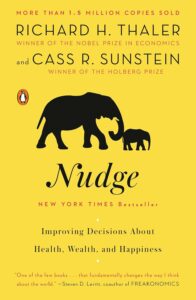
Nudge: Improving Decisions About Health, Wealth, and Happiness
Author: Richard Thaler and Cass Sunstein
Publisher: Yale University Press
384 pages | 2021
Purchase
[If you purchase anything from Bookshop via this link, I get a small percentage at no cost to you.]