The Non-fiction Feature
Also in Bulletin #50:
The Memoir Spot: Just Add Water by Katie Ledecky
The Product Spot: Ted Lasso
The Pithy Take & Who Benefits
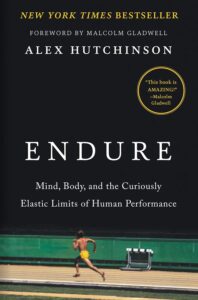
Over the past decade, journalist and runner Alex Hutchinson has traveled to labs across the world and spoken to hundreds of scientists, coaches, and athletes, to try and understand what endurance is and what its limits are. The book is filled with descriptions of experiments, from brain electrode jolts to computer-based training to physical training, and the decades of research that have gone into attempting to answer those questions.
I think this book is for people who seek to understand:
(1) an overview of scientists’ search for understanding human fatigue and the limits of humans’ physical capabilities–specifically, the interplay between pain, muscle, oxygen, heat, thirst, and fuel;
(2) how a crucial part of examining endurance is how the brain responds to distress signals; and
(3) how we can train ourselves to improve our brains’ responses.
The Outline
The preliminaries
- It’s actually quite difficult to explain the “limits of endurance.”
- The will to endure can’t be tied to any single physiological variable, and the difference between physical and psychological endurance is not clear-cut.
- Specifically, the psychology and physiology of endurance are inextricably linked: any task lasting longer than a dozen or so seconds requires decisions, conscious or not, about how hard to push and when.
- The science of how we pace ourselves is surprisingly complex.
- Over time, as the mysteries of muscle contraction (including discoveries of lactic acid and oxygen consumption) were gradually unraveled, an obvious question emerged: what are the human body’s ultimate limits?
- You might think the best test of maximal endurance is a race. But race performance depends on highly variable factors, like pacing. Really, it’s a test of your performance on that given day, not of your ultimate capacity to perform.
The central governor
- The brain’s role in endurance is a controversial topic in sports science.
- Many years ago, scientists held the “body as machine” view, where the body set the limits, and the brain dictated how close you get to those limits.
- But starting in the late 1990s, a South African physician named Tim Noakes argued that this was insufficient; rather, it was actually the brain alone that set and enforced the limits we encounter during prolonged exercise.
- The “central governor” concept is generally:
- Whatever our limits are, something prevents us from exceeding them by too much, and that something must be the brain.
- That is, the limits we encounter during exercise aren’t a consequence of failing muscles; they’re imposed in advance by the brain to ensure that we never reach true failure.
- It’s the idea of “anticipatory regulation”: the brain might sense distress signals from elsewhere in the body and shut things down when the warnings exceed a critical level.
- For instance, exercise in the heat: if you run to exhaustion on a treadmill in a hot room, your brain will stop pushing your muscles when your core temperature hits a critical threshold of about 104 degrees Fahrenheit.
- But Noakes theorized that the brain gets involved long before you reach that critical temperature. You don’t hit 104 and pass out; you slow down and run at a pace that keeps you below 104.
- To do this, the brain controls how much muscle is recruited at a given effort level.
- The “central governor” concept is generally:
- The author asked Noakes for the single most convincing piece of evidence in favor of the central governor theory, and he said, “the end spurt”:
- Conventional physiology suggests that you get fatigued during a run, as muscle fibers fail and fuel stores are emptied.
- But then, when the end is in sight, many can speed up. Clearly your muscles were capable of going faster, so why didn’t they?
- This strongly suggests that the brain holds you back during long efforts and releases the final reserves when you’re nearly finished and the danger is passed.
- And there’s good reason to think that pacing is driven as much by instinct as by choice.
- Around the age of eleven or twelve, our brains learn to anticipate our future energy needs and hold back something in reserve.
- Despite all this, endurance isn’t simply a dial in the brain; it’s a complex behavior that involves nearly every brain region.
The conscious quitter
- Exercise scientist Samuele Marcora put together a provocative study of mental fatigue.
- He asked 16 volunteers to finish time-to-exhaustion tests on a stationary bike.
- Before one of the cycling tests, the subjects spent 90 minutes performing a mentally exhausting computer task that involved watching a series of letters flash on a screen and clicking different buttons as quickly as possible.
- Before another cycling test, the subjects spent the same 90 minutes watching a pair of emotionally neutral documentaries.
- After the computer task, the subjects gave up 15.1% sooner than after watching the documentaries.
- It wasn’t physiological fatigue: heart rate, blood pressure, oxygen consumption, and lactate levels were identical during the two trials.
- The only difference was that the mentally fatigued subjects reported higher levels of perceived exertion.
- Otherwise put, when their brains were tired, pedaling a bike just felt harder.
- In Marcora’s perception, perceived exertion is the single best indicator of the degree of physical strain, since it integrates information from muscles and joints, the cardiovascular and respiratory systems, and the central nervous system.
- If the effort feels easy, you can go faster. If it’s too hard, you stop. And, there are lots of ways you can alter your sense of effort, and thus your apparent physical limits, without altering what’s happening in your muscles.
- So, getting mentally fatigued increases your sense of effort and thus reduces endurance.
- He asked 16 volunteers to finish time-to-exhaustion tests on a stationary bike.
- As such, anything that moves the “effort dial” in your head can affect how far or fast you run.
- Marcora believes that if you could train the brain to become more accustomed to mental fatigue, then, just like the body, it can adapt and the task of staying on pace would feel easier.
- It’s unclear whether this is fully correct – scientists are currently fighting about it with no end in sight.
Pain
- To most people, endurance and pain are tightly connected.
- Pain is many things: a sensation, like vision or touch; an emotion, like anger or sadness; and a “drive state” that compels action, like hunger.
- Among the first to study pain perception in athletes was psychologist Karel Gijsbers.
- In experiments, top athletes were not immune to pain, but overall could withstand higher levels of pain than non-athletes.
- This leads to the question: Can you get faster by simply training yourself to better tolerate or block out pain?
- In one study, giving well-trained cyclists a dose of Tylenol boosted their performance in a 10-mile time trial by about 2% compared to when they were given a placebo.
- Less pain makes the effort feel easier.
- (But this experiment isn’t even that clear, because Tylenol also fights fever. Could its endurance-boosting benefits result from its ability to help prevent your core from overheating, rather than from its pain-blocking effects?)
- But, without pain, we cannot efficiently pace ourselves.
- In the real world, we don’t just run to the point of failure; we pace ourselves to go as fast as possible while never reaching failure. The process of managing fatigue over a long period of time puts a greater emphasis on managing pain.
Muscles
- Muscles have limits, and some experiments have revealed that your muscles hold capacity in reserve.
- In one experiment, subjects were told to do five-second bicep curls every fifteen seconds. The subjects were told not to pace themselves, and that each contraction was supposed to be done as hard as possible.
- One group was told they’d be doing six contractions; another was told they’d be doing twelve; and the third was told to continue until instructed to stop.
- But once the experiment started, all three groups ended up doing twelve.
- In theory, the instructions shouldn’t have made any difference. But in reality, expectations mattered.
- Those who thought they were only doing six produced slightly more force than the twelve-rep group, and those with no information produced the least force.
- So, even in short, supposedly all-out maximal contractions, when we’re explicitly told to hold nothing in reserve, we still pace ourselves.
- In one experiment, subjects were told to do five-second bicep curls every fifteen seconds. The subjects were told not to pace themselves, and that each contraction was supposed to be done as hard as possible.
- Ultimately, trying to cleanly separate “brain fatigue” and “muscle fatigue” is difficult, because they’re inseparably linked.
Oxygen
- There is no limit more fundamental than oxygen.
- There’s a difference between when the body wants more oxygen and when it actually needs it–understanding this difference is critical to understanding the role oxygen plays in the limits of endurance.
- In short, the urge to breathe (driven by a build-up of carbon dioxide rather than a lack of oxygen) is a warning signal that you can choose to ignore–up to a point.
- The mammalian dive reflex offers insight into how our brain functions regarding anticipated oxygen level changes.
- Your heart rate drops when you go underwater, and you have a massive peripheral vasoconstriction:
- The blood vessels in your arms and legs squeeze nearly shut, sending blood back to your core, where it maintains the crucial oxygen supply to your heart and brain for as long as possible.
- The fact that people can dive to three hundred feet or hold their breath for 12 minutes means that oxygen’s absolute limits aren’t quite as constrictive as they feel–we’re protected by many layers of reflexive safety mechanisms.
- Diving reflexes are controlled by the autonomic nervous system, which controls a wide range of bodily functions like heart rate, reheating, and digestion.
- Scientists found that if you strap on a heart-rate monitor, your heart rate begins to plummet just before you dive into the water.
- Think of this as anticipatory regulation: your brain uses knowledge that is gathered consciously, like an impending dive or a finish line, to turn safety mechanisms on or off.
- Your heart rate drops when you go underwater, and you have a massive peripheral vasoconstriction:
- Another study offers further evidence that endurance depends, in part, on oxygen levels in the brain.
- One scientist had his subjects perform repeated arm flexes to exhaustion at varying altitudes, but he blocked off blood flow to the arm with a tight blood-pressure cuff.
- So, despite the variations in altitude, the arm muscles received the same amount of oxygen (that is, none) in each case.
- But, time to exhaustion was reduced by 15% at the highest altitude–a consequence of lower brain oxygenation.
- So, is oxygen a “real” limiting factor in endurance?
- While the world’s best breath-holders certainly have some unique physiological skills, it’s clear that initial progress in breath-holding (going from one minute to three) is mostly a matter of ignoring the rising sense of panic.
- Another way to see it is that feelings and emotions are as physiologically real as changes in core temperature or hydration levels, and are mediated by chemical signals.
- So when oxygen levels in the brain drop, does our safety circuitry slow us down, or do we simply decide to slow down? Whatever the answer, the outcome is clear: we slow down.
Heat
- For every 100 calories of food you eat, you might get 25 calories of useful work and 75 calories of heat.
- It’s surprisingly similar to the efficiency of a typical internal combustion engine.
- The heat generated by your car’s engine is very useful on a cold day: it’s what blasts through your vents to warm up the inside.
- The same is true for human heat production, which is why even extreme cold is rarely a limiting factor for people like endurance athletes, whose furnaces burn far hotter than most.
- For athletes, the biggest cold-related problems arise when your activity level changes, like if you get too tired to maintain the effort level that has been keeping you warm.
- But far more common are problems that arise in hot weather, because you’ve got no way of actively cooling yourself, so the best you can do is get rid of excess heat as quickly as possible.
- Blood vessels in your skin dilate dramatically to allow eight liters of blood per minute to course through them and dump heat to the air around you.
- You also begin to sweat (the transformation of liquid water to vapor), creating a powerful cooling effect on the skin.
- There’s a reason athletes drape ice towels over their necks and use other cooling mechanisms: such interventions don’t alter your core temperature, but they do influence how hot you feel, and that, in turn, dictates how hard you’re able to push.
- We instinctively moderate our pace to stay below the critical temperature threshold that makes people keel over in heat.
- So, when you run a 10k on a hot summer, your pace is actually slower right from the start, long before your body has even begun to warm up.
- And motivational self-talk helps, too.
- In one test, a self-talk group improved their performance on an endurance tests from 8 minutes to 11 minutes, and in doing so, pushed their core temperatures at exhaustion more than half a degree higher.
- There seems to be a strong mental-psychological component: the right frame of mind can allow you to push beyond your usual temperature limits.
Thirst
- The human body is about 50% – 70% water, and it needs pretty much all of it. You’re constantly losing water, not just from sweat and urine, but also subtle leaks like the moisture in your breath.
- And, under normal circumstances, you’re constantly replacing it by eating and drinking. Your fluid balance fluctuates a bit throughout the day, but from one day to the next it’s actually regulated with remarkable precision.
- When you don’t sufficiently replace lost fluids, you start craving a drink, and your kidneys begin reabsorbing fluid that would otherwise become urine.
- If that’s not enough to restore your internal balance, fluid will start draining out of your cells and into your veins and arteries to maintain the necessary volume of blood pumping through your body.
- Eventually your blood will get so concentrated that your brain will start shrinking, ultimately killing you.
- In 1965, a security guard named Dwayne Douglas at the University of Florida’s Health Center was chatting with one of the researchers, who specialized in kidney medicine.
- Douglas, who was also a volunteer assistant for the Gators football team, was confused by how much weight his players lost.
- The researcher tested players during practices and eventually came up with a drink containing water, sugar, and salts to replace what the players were losing in sweat to restock the fuel stores that muscles burn through.
- In games, the better-hydrated team would surge ahead while the other team did not. And thus, the drink that would become known as Gatorade was born.
- There is also a seemingly contradictory pattern with hydration and heat–heatstroke without dehydration, dehydration without heatstroke–but it is not a fluke.
- Dehydration is a greater concern in longer races, because you have more time to sweat; heatstroke, in contrast, is most common in shorter races.
- That’s because your body temperature is primarily determined by your “metabolic rate”–that is, how hot your engine is running.
- In a 30-minute race, you can sustain a fast enough pace to drive your core temperature all the way up, even though you don’t get seriously dehydrated.
- In a three-hour race, in most circumstances, you simply can’t sustain a hard enough pace to push your temperature into heatstroke territory, even though you might get seriously dehydrated.
- How do we reconcile the chasm between the lab and real-world effects of dehydration?
- The first step is to make a distinction between thirst (the feeling of wanting a drink) and dehydration (the state of having lost fluids relative to your normal levels).
- While being thirsty virtually always indicates that you’re dehydrated, the concept of “voluntary dehydration” illustrates that being dehydrated won’t always make you thirsty.
- It’s worth considering what thirst is for. The simplest explanation is that it’s the body’s way of ensuring that you keep your fluid levels normal.
- And instead of monitoring fluid levels, your body monitors “plasma osmolality,” which is the concentration of small particles like sodium and other electrolytes in your blood.
- As you get dehydrated, your blood gets more concentrated, and your body responds by secreting a hormone that causes your kidneys to reabsorb water, and by making you thirsty.
- Unlike your body’s fluid levels, plasma osmolality is very tightly regulated: when you’re looking at the right variable, your thirst sensation doesn’t make mistakes.
- This disconnect between thirst and water loss may actually be an evolutionary advantage rather than a bug. Our ability to run long distances over the hot savannah gave us a crucial advantage over other species, and to do that, we had to be able to tolerate temporary periods of dehydration without negative effects.
- Avoiding thirst, rather than avoiding dehydration, seems to be the most important key to performance.
- One study found that swallowing small mouthfuls of water–too small to make any difference to overall hydration levels–boosted exercise performance by 17% compared to rinsing the same amount of water in the mouth and then spitting it out.
- When it comes to quenching your thirst, perception–not just in your mouth, but in the cool flow of liquid down a parched throat–is at least in part, reality.
Fuel
- When your car runs out of gas, it stops–your body behaves similarly. The fuel you use is supplied by food, which contains energy stored in the form of chemical bonds, which are broken as the food is metabolized, releasing energy that powers you.
- But it’s not just about quantity; endurance also depends on the type of fuel, where it’s stored, and how quickly you can access it.
- The three basic fuel options are protein, carbohydrate, and fat.
- While protein is important for building and repairing muscles, it doesn’t do too much for directly fueling muscle contractions. For the most part, carbs and fat fuel you for prolonged exercise.
- Early experiments showed that the balance between fat and carbohydrate use depends on how hard you’re working.
- During easy exercise, like a gentle walk, you burn mostly fat from what’s in your bloodstream. As you increase intensity, you add more carbs to the mix.
- The actual blend depends on a variety of things: the fitter you are, the greater proportion of fat you burn at any given speed.
- There’s different fuel that’s good for different types of endurance.
- If you just want to cover the most distance, the ability to tap into fat stores is very useful.
- If you’re interested in speed, then your primary fuel-related concern isn’t so much quantity, but the speed at which you can access your fuel.
- This leads to several important questions: how quickly do your muscles burn fuel? How quickly can they access your fuel stores? And how quickly can you restock on fuel?
- Researchers have shown that glycogen stores in your muscles aren’t just energy reservoirs; they also help individual muscle fibers contract efficiently.
- That means your muscles weaken as you burn through your glycogen stores, draining your strength before you’re actually out of fuel.
- In effect, your muscles have a self-defense mechanism that’s totally independent of the brain.
- One study also confirmed the performance benefits of swishing and spitting a carbohydrate drink–magnetic resonance imaging showed that brain areas associated with reward lit up once subjects had carbohydrate in their mouth.
- Our mouths contain sensors that relay the presence of carbs directly to the brain, and it’s as if the brain relaxes its safety margin when it knows (or is tricked) that more fuel is coming. This explains why carbs offer a boost more or less instantly.
- It’s some of the strongest evidence we have that your brain looks out for your well-being in ways that are beyond your conscious control and that kick in long before you reach a point of actual physiological crisis.
- Researchers have shown that glycogen stores in your muscles aren’t just energy reservoirs; they also help individual muscle fibers contract efficiently.
- The two main fuel options have complementary strengths and weaknesses–carbohydrate as fast fuel with limited storage capability, fat as an inexhaustible but rate-limited alternative.
Training the brain
- The biggest driver of extended endurance is effort. How do you train effort? Train your body.
- If you want running a 5-minute-mile pace to feel easier, you should run at that pace, a lot.
- Practice enables you to sustain that pace with less physiological strain, and will also attenuate the distress signals that your muscles and heart send back to the brain.
- Ultimately, the process of training expands the capabilities of the muscles and heart, and it recalibrates the brain’s horizons.
Belief
- Self-confidence can make you try harder–but it can also work in more subtle ways.
- For example, telling runners that they look relaxed makes them burn less energy to sustain the same pace.
- Giving players a postgame debriefing that focuses on what they did right rather than what they did wrong has effects that continue to linger a full week later, when the positive-feedback group will have higher testosterone levels and perform better in the next game.
- The author believes that most of us can do a better job of accessing those “hidden reserves”; in particular, this is a ripe area of improvement for those who are already training at a high level.
And More, Including:
- Interspersed throughout the book are outtakes from Nike’s Breaking2 project at the Nike Sport Research Lab – can a human run a marathon in under two hours?
- The relation between impulse inhibition and endurance
- How to improve your response inhibition when training your brain to expand its endurance capabilities
- Zapping the brain to determine what role the brain plays in setting our physical limits, and whether we can change those limits by trickling a small electric current through the brain’s motor cortex
Endure: Mind, Body, and the Curiously Elastic Limits of Human Performance
Author: Alex Hutchinson
Publisher: Mariner Books
336 pages | 2021
Purchase
[If you purchase anything from Bookshop via this link, I get a small percentage at no cost to you.]