The Non-fiction Feature
Also in Bulletin #56:
The Poetry Spot: Affrilachia by Frank X. Walker
The Product Spot: Pew Research Center
The Pithy Take & Who Benefits
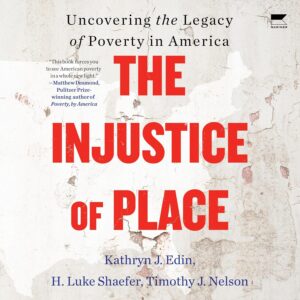
Professors Kathryn Edin, Luke Shaefer, and Timothy Nelson embark on a remarkable exploration of America’s most disadvantaged places. Nearly all these places are rural, and are steeped in histories that look like emblems of America’s dream, but are actually the very things that have held them back.
I think this book is for people who seek to understand:
(1) the common hallmarks of the places of deepest disadvantage, such as unequal schools and single-commodity economies that launched a handful of people to wealth and exploited the labor of thousands;
(2) the common hallmarks of the places of greatest advantage; and
(3) what can be done to pull the places of deepest disadvantage away from the brink.
The Outline
The preliminaries
- When the researchers traveled across the country to the most deeply disadvantaged places, it became clear that it was home to not only desperate poverty but also considerable wealth.
- To assess the level of disadvantage in a community like a county or city, the researchers combined income-based measures with other markers like health.
- Lately, it has become clear that a person’s health is very much shaped by environment and context–income, family circumstances, and community characteristics–rather than genetic profiles or medical care.
- Another critical way to measure disadvantage is to include the rate of mobility from one generation to the next.
- That is, how easy is it for the younger generation to move beyond their parents’ class?
- To assess the level of disadvantage in a community like a county or city, the researchers combined income-based measures with other markers like health.
- The researchers use the term “deep disadvantage” to capture the complexity of the problem when a person’s life chances are hindered by multiple variables.
- They found that the most disadvantaged places were mostly rural.
- And although many of these places were majority white, there were many more that were Black and Hispanic Americans.
- Plus, many places with large Native American populations were among the most disadvantaged.
- Apart from predominantly Native American populations, the places that were most disadvantaged, and which are the focus of this book, are: Appalachia, South Texas, and the expansive southern Cotton Belt that runs across seven states.
- As they dug into the histories of these areas, they realized that all shared a history of intensive resource extraction and profound human exploitation, unmatched in other areas of the U.S.
- All the places also had intense local government corruption, unequal schooling, collapsed social infrastructure (places like libraries and bowling alleys, where people build social bonds), violence, and structural racism in government programs.
America’s internal colonies
- Rural U.S. is filled with monuments, celebrations, and museums that mark local pride.
- (Crystal City, Texas, for instance, calls itself the “Spinach Capital of the World.”)
- These markers commemorate the very industries that, for decades, caused misery and hardship for thousands, if not millions, while profiting only a few.
- They represent the intensive resource extraction and human exploitation that made these places America’s internal colonies.
- How did the identities of these communities become so bound to past economic legacies?
- On the surface, geology is critical.
- Think coal mining in Appalachia, or the incredible soil of the Mississippi Delta that led to so much farming.
- But geology alone, though necessary, wasn’t enough to produce such vast industries.
- There was also the acquisition of land, capital, and access to national and global markets.
- Above all, though, was an ample supply of exploitable people for cheap labor.
- On the surface, geology is critical.
The Cotton Belt
- In Savannah, Georgia, you could drive through I-95 and travel within a mile of the spot of one of the most consequential events in American history.
- That spot is a piece of land that the U.S. government gave to General Nathaneal Greene after the Revolutionary War; after his death in 1786, his widow, Catherine, used the plantation and experimented with planting short-staple cotton.
- In 1793, Eli Whitney traveled South to take a tutoring post, but a fellow traveler invited him to work at the Greene plantation for more money.
- Catherine asked Whitney if he could find a way to separate cotton fibers from the seeds, and he, along with Catherine and several of the plantation’s enslaved people, created the cotton gin.
- The cotton gin changed the course of history by doubling the market value of the crop, and the great cotton rush was on.
- As cotton plantations spread like a rash across the South, so did slavery.
- Greenwood, Mississippi exemplifies the rapid expansion of cotton wealth.
- Cotton wealth led to the rise of a regional elite, which stood in stark contrast to legions of impoverished laborers.
- Plantation life among black people was essentially an unending forced labor camp.
- Beyond that, even after the Civil War, landlords short-changed their tenants, and blocked their access to government relief.
- Cotton wealth led to the rise of a regional elite, which stood in stark contrast to legions of impoverished laborers.
- Greenwood, Mississippi exemplifies the rapid expansion of cotton wealth.
Tobacco in the Pee Dee
- In the 1870s near the Atlantic Coast, a farmer, upon the advice of a visiting clergyman, began growing bright leaf tobacco.
- From here, tobacco took off, and by the first decade of the 20th century, the Pee Dee region of South Carolina was literally transformed.
- There were thousands of curing barns, warehouses, banks, stores, homes, and jobs.
- Similar to other regions discussed in the book, Pee Dee also experienced exploding growth and near-complete market domination.
The winter garden of south Texas
- For south Texas, it was onions.
- In the late 1890s, Thomas Carter produced a bumper crop of onions, grown from seed imported from Bermuda, and netted a profit of $200/acre.
- Bumper crops spurred a rush to convert ranchland to irrigated farms.
- In this rush, laborers poured in from Mexico to work on spinach, onions, and other crops.
- One of the most important resources south Texas offered was the nearly inexhaustible labor supply from Mexico.
- White landowners began adopting laws and practices similar to those used in the Cotton Belt to control black labor.
- For instance, they used not only minimal wages but also labor controls, armed guards, whipping, and near starvation diets.
Coal in central Appalachia
- In the 1850s, Jebediah Hotchkiss, a mapmaker, did on a walking tour through Appalachia.
- One day, he saw several large coal outcroppings along Virginia’s Flat Top Mountain.
- He hired prospector, who discovered a coal seam 13 feet high, which was twice that of any then known in the U.S.
- With that, Hotchkiss ushered in the industrial age in western Virginia, and soon coal mining spread across central Appalachia.
- But before this happened, control over the land had to be taken from the Native people living there. Ultimately, after bloody fights and a series of illegal actions, they did so.
- After that, areas like Clay County exhibited extreme economic inequality–a characteristic of all our internal colonies.
- The territory was largely owned by a few men.
- Agents of big corporations descended on rural settlements throughout Appalachia, scouting for timber and coal.
- The agent would go to farming families, produce a bag of coins, and offer to purchase a tract of unused ridge land, or the mineral rights to the property.
- Cash-poor farmers would sign “broad form deeds,” which transferred to the coal companies not only the mineral wealth but also the right to remove it by whatever means.
- As Appalachian coal mining took off, the companies’ need for labor expanded dramatically.
- Operators pulled in many immigrants from eastern Europe, and the danger to miners was immense, with constant risk of death or disability.
The living legacy of America’s internal colonies
- Read one way, these internal colonies represent innovation, ingenuity, and entrepreneurship.
- Great wealth stemmed from these regions and fed national and global markets.
- Yet these are the places with the most inequality, severe poverty, poor health, and limited mobility. They remain so today.
- The parallels between America’s internal colonies are inescapable.
- Rather than getting laborers through competitive wages, the capitalist class closed off competition.
- Owners made sure that the pay was terrible and that workers were stripped of suffrage, thereby undermining investment in schools and other civic infrastructure.
- The parallels between America’s internal colonies are inescapable.
Separate, unequal
- All of the internal colonies failed to invest in education–the work in those regions required strong bodies, not strong minds.
- Additionally, after Brown v. Board of Education (1954), in the following years, many Cotton Belt whites effectively undid Brown by creating all-white, private “segregation academics” to explicitly maintain segregated schools.
- Similarly, in south Texas, whites retained control of the school board, and as such, students were mostly separated by ethnicity.
Before Brown in the Cotton Belt
- Cotton Belt counties really drove in the concept of separate and unequal–Black Americans made up large majorities of the population, but funding earmarked for black schools was frequently diverted to white schools.
- Plus, county governments paid for the creation of white schools, whereas black parents had to provide spaces for black students to learn; similarly, buses took white rural children to and from school, while black children had to walk.
- Ultimately, the most consequential factor in lower academic achievement for black students was the short school year.
- Their school year was only a few months, which was half of that as white students, but they had the same grade system, which meant that black students were rushed through the material at an excessive pace.
Segregation academies
- Among the Cotton Belt counties, whites in the Delta, rich in income and property, were best positioned to donate the land for, fund the construction of, and pay the tuition for the new schools.
- Segregation academies also helped ensure that white supremacist beliefs were passed onto the next generation.
- Segregation academies were supported by the Citizens’ Councils (“uptown Klan”) and Southern Baptists.
- Research conducted for this book shows that for the 140 most disadvantaged counties in the South, nearly half had at least one all-white private school.
- As this pattern emerges, it becomes clear that the places of deep disadvantage all had pasts where their school systems were significantly segregated by ethnicity and race.
Today
- These days, our schools are still segregated by ethnicity and race.
- Segregation is a key mechanism whites have used to undercut the chance that black and hispanic children can do better than their parents.
- What are the effects of this on black, Hispanic, and white children?
- Researchers have discovered that twelve years of desegregated schooling for black children was enough to eliminate differences in black-white educational attainment.
- How do those benefits reverberate through a student’s lifetime?
- By comparing the average effects of five years of exposure to a desegregation order among black students to no years of exposure, there was an increase in an annual work hours and wages that combined to produce a 30% bump in annual earnings in adulthood, a significant decrease in poverty, improvements in marital stability, and an increase in the likelihood of being in good or excellent health.
- Being exposed to a desegregation order beginning in the elementary grades also yielded a 22% reduction in the probability of being incarcerated as an adult.
- Meanwhile, white children who experienced desegregation did as well on all those metrics as those who had not been exposed to a desegregation order.
- The conclusion: no one lost.
Nothing to do here but drugs
- America’s internal colonies are some of the sickest places in the nation.
- But, sickest of all is central Appalachia.
- The most disproportionate cause of death here is the sharp rise in mortality due to drug overdose.
- For example, in 2019, a pastor in Clay County Kentucky learned that kids in his community were getting addicted, overdosing, and even dying.
- And not just kids from rougher backgrounds–this also happened to kids of local business owners and other community leaders.
- In many ways, Big Pharma digging in its claws in central Appalachia is similar to what Big Coal did, and here the resource extraction is the health of the bodies of the community’s most vulnerable residents.
- In this modern-day version of capitalist extraction, capitalists depend on the local family practitioner and pharmacist willing to turn a blind eye to do their bidding.
- Why central Appalachia?
- While it’s true part of the rise of fatal overdoses can be attributed to long-term decline in the life chances of the white working class, that’s not the whole story.
- Purdue Pharma intentionally chose central Appalachia to market OxyContin.
- That is, there were so many family physicians, and Purdue assumed that they would be more naive and thus more susceptible to persuasion.
- Beyond that, this region tops the nation in disability pay–people on worker’s comp or disability automatically qualify for Medicaid, which provides a means to pay for OxyContin.
- While it’s true part of the rise of fatal overdoses can be attributed to long-term decline in the life chances of the white working class, that’s not the whole story.
- The decline of social infrastructure
- The researchers spoke to many people who said that there was “nothing to do here but drugs.”
- Resident after resident in Clay County, whether middle-class or poor, linked the opioid crisis to the loss of places like the bowling alley, the rollerskating rink, the pool, and movie theaters.
- Otherwise put, crumbling social infrastructure seems to have contributed to the rise of drug abuse.
- To explain, voluntary associations are the key to building social bonds. Places that foster and create these associations can be thought of as social infrastructure.
- In the book Palaces for the People, sociologist Eric Klinenberg argues that the future of democratic societies rests not only on shared values but on shared spaces: the libraries, childcare centers, bookstores, churches, synagogues, and parks, in which crucial, sometimes life-saving connections are formed.
- When social infrastructure gets degraded, the consequences are unmistakable.
- Researchers have found that the density of nonprofits and civic organizations, plus voting and other behaviors within a community are strongly tied to overdose death rates.
- The researchers spoke to many people who said that there was “nothing to do here but drugs.”
- While opioids may impersonate love, it is clear from our research that they increase the agony of social isolation.
- In a series of interviews for this book, lower-income participants emphasized that they tried very hard to keep to themselves.
- For some, the enormous prevalence of drug addiction has led to complete withdrawal from the community; addiction also tears at the fabric of the nuclear family.
- A question remains: How did the loss of these places, and the bonds they created, etch themselves into the bodies of the residents and the fabric of the community there?
A tradition of violence
- Lynchings were a critical part of Cotton Belt society, and served the explicit goal of racial subjugation.
- For instance, in 1889 in the Delta, in Leflore County, black farmers held a meeting where they tried to find ways to improve themselves financially, and one suggestion was to encourage other farmers to stop purchasing from local white merchants.
- Local whites found out and a white vigilante mob pulled black men, women, and children from their homes and shot them.
- The economic and social relations of these communities, decades ago, still shape their fortunes today. Specifically, violence links the events of the past to the present.
- While lynchings are very much a part of the history of Black Americans, they are equally fundamental to the history of white Americans.
- White people gathered mobs and pursued victims, and white law enforcement either turned a blind eye or were actively involved.
- While lynchings are very much a part of the history of Black Americans, they are equally fundamental to the history of white Americans.
- For instance, in 1889 in the Delta, in Leflore County, black farmers held a meeting where they tried to find ways to improve themselves financially, and one suggestion was to encourage other farmers to stop purchasing from local white merchants.
- It’s critical to understand precisely how violence operated in the Cotton Belt, then and now.
- White people felt that they always had to be ready to maintain their position of authority, even through physical violence. They controlled all means of official law enforcement: the police, judges, and all-white juries.
- Underlying much of this fear was the myth that physical contact with black people was polluting.
- There was also the fear that a black man would soil a white woman’s virtue, which led to the thinking that it was safer to lynch blacks than to endure attacks on white women.
- However, the real rapists were almost always white, and the victims were almost always Black.
- Black people had to be vigilant. Even the slightest misstep could lead to severe consequences.
- Lynching was the ultimate tool because it reverberated so powerfully throughout the Black community, particularly among the young.
- The point of lynching wasn’t to punish the individual, but to keep the entire community down.
- White people felt that they always had to be ready to maintain their position of authority, even through physical violence. They controlled all means of official law enforcement: the police, judges, and all-white juries.
- Violence is heavy in rural areas.
- Between 1999 and 2013 (after accounting for population size), gun deaths were most likely to occur in counties that were poor and rural.
- Appalachia and the Cotton Belt are among the most violent places in the nation.
- Research has directly linked a history of violence in a region to violence in the present day.
- For instance, in southern states, the high number of lynchings is strongly associated with the current high rates of homicide. That is, through the years, white elites used a variety of other means to keep Blacks down.
- A child’s exposure to community violence may lead to long-term trauma and delayed cognitive development.
- Community violence also hinders intergenerational social mobility, which is the chance that a child who grows up poor can rise to the middle class or beyond.
- But what if the opposite of this is true? What if blocked mobility leads to violence?
- If you live with the constant sense that you cannot get ahead, in conjunction with the lack of ability to defend yourself against white reprisals, means that the anger boiling up in the Black community has no outlet except against each other.
- But what if the opposite of this is true? What if blocked mobility leads to violence?
- Researchers have found that a low probability that a poor child growing up in a community could rise to the middle class was a powerful predictor of a high rate of violence in that community.
- This relationship was more important than the number of officers or the level of inequality–it rivals the community’s poverty state as an indicator of violence.
Little kingdoms
- Corruption is common in America’s internal colonies, and it’s a key mechanism through which the sins of the past wreak havoc on the present.
- For example, in Mississippi, Nancy New, founder of the nonprofit Mississippi Community Education Center, conspired with the director of the Mississippi Department of Human Services to embezzle or redirect $77 million from the TANF program.
- Plus, a 2020 audit alleged New’s nonprofit paid that NFL player Brett Favre over a million for speaking events, and he was texting New about whether there was any way the media could discover this payment.
- There are plenty of celebrity “welfare recipients”–they privatize government programs and get cushy jobs for their friends.
- Corruption stunts economic growth and instills in a region a disadvantage so deep that it persists even in the face of substantial federal aid.
- For instance, Clay County has had over a century of corruption.
- It began with salt, which led to the first capitalist enterprise in central Appalachia.
- The salt industry laid the foundation for the political and social order that still exists in the county–there was severe inequality not only between the enslaved people and their owners, but also between capitalists and subsistence farmers.
- James White became one of the area’s most powerful men, and built an economic and political sphere of influence through a series of public offices that he and his family held.
- They held enormous power–as highway commissioners, they could order the building of roads that linked their mines to regional transportation, they could compel locals to undertake road maintenance and improvements, appointed patrols to monitor things, and they reimbursed themselves for many things at the taxpayers’ expense. And as justices, they could remove children from poor families and bind them as apprentices to the wealthy.
- When the War on Poverty infused more than $1.5 million in federal funds to that community, the county was supposed to ensure that there was participation from all groups, including the poor.
- This was a direct challenge to the local political machine, so local officials mounted an intimidation campaign to make sure that the population voted only for specific people.
- Clay’s board was eventually defunded for self-dealing.
- For instance, Clay County has had over a century of corruption.
- Corruption shows that even in one of the most deeply disadvantaged places in our nation, there are still plenty of spoils ripe for capture.
- There is also a very strong mindset of “good rich people, “bad poor people.”
- This narrative shields the elite with having to grapple with the level of poverty that exists in the poorest white-majority place in the nation.
- Specifically, there is a lot of concern about whether people collect a government check.
- In reality, very few people collect a check; this leads to the question: what is really holding people back? A small fraction of people collecting a government check, or persistent and rampant corruption in the institutions charged with serving them?
- Similar to colonies established by foreign nations around the world, which begin and end with corruption, so too do America’s internal colonies.
- Corruption is seldom recognized as an explanation of why an elite few live off the spoils of public office to preserve the status quo.
- With rampant corruption, it is nearly impossible for a community to improve.
The invisible hand
- Structural racism is another challenge that is deeply rooted in the internal colonies.
- Take Marion, South Carolina, for instance. The rural community is majority Black. Per the Gini index, the divide between the haves and have-nots in the internal colonies is just as wide, if not wider, than in highly unequal cities.
- Beyond this, Marion county is one of the places that is hit the hardest by severe weather. But only a small portion receive aid.
- One of the primary reasons is that people have difficulty proving that they own their homes. For many, their property came into their possession when their parents died, but title did not legally transfer; this is known as heir’s property.
- At that time, FEMA had a color-blind policy regarding who needed a title, but the adverse effects of these policies fell disproportionately on Black people–treating people equally led to a sharply inequitable outcome.
- Studies have estimated that roughly half of all land owned by Blacks in the South might be held as heir’s property.
- So, millions of acres, valued in the billions of dollars, are owned in this manner. Same in Appalachia. It really limits the value of what is probably most people’s chief form of wealth.
- Additionally, the industries tied to those regions are sources of environmental degradation.
- For example, the hog farms in southeastern North Carolina are disproportionately built in Black communities, leading to higher rates of mortality and elevated levels of kidney disease.
- Industrial agriculture, as practiced in South Texas, the Cotton Belt, and the Pee Dee region, consume fossil fuels and water at unsustainable rates. Same with mining.
- In job-starved areas, community leaders–who are usually white–push for more jobs at any cost, regardless of the environmental impact.
- And when a natural disaster strikes, government policies that kick in afterwards deepen the inequalities.
- The structural racism that permeates the regulations of federal agencies such as FEMA is built on decades of discriminatory practices.
Revolt and retribution
- If things are so bad in the internal colonies, why don’t people revolt?
- The truth is, periodic revolt does happen–leading to things like increased unionization–but violent retribution, by those desperate to retain power, often comes afterwards.
- In the future, when revolt comes, especially when it comes to officeholding, it is critical for people to get technical support and opportunities to hone the craft of leadership.
- That is, holding and office, and navigating politics, is incredibly difficult. All too often, newcomers get there, fall short because of a lack of resources, and society uses it as evidence that they shouldn’t have been allowed to try in the first place.
The sins of our fathers
- Why is the labor participation rate so low in America’s internal colonies?
- First, many schools fail to produce graduates who have the skills for many of these jobs.
- Second, many are hampered by criminal records.
- Third, the nature of the work available–the assembly line, processing plant, etc.–are not appealing.
- (One thing that is not a reason is welfare–many states in the south have low benefit levels that are nowhere near enough to be the key driver of low labor participation rates.)
- What if employers overstate their inability to find workers as a way to distract from the low wages they provide? If worker supply were truly a barrier to production, wouldn’t the employers just leave?
Healing America’s internal colonies
- The authors and their research team also took a look at the places of greatest advantage.
- These places are in the upper midwest: counties in Minnesota, the Dakotas, Nebraska, Iowa, and Wisconsin.
- Poverty rates are low, babies are born healthy, most people live to an old age, and a low-income child usually has the same chance to make it into the middle class as any other kid.
- There are significant investments in schools and low rates of violent crime.
- They are rich in social capital: residents are connected to one another through volunteerism, civic organizations, and other community activities.
- Very low public corruption.
- Many places had dozens of farmsteads, which starkly contrasts the vast, uninterrupted fields in the places of deep disadvantage.
- That is, they are marked by a sheer lack of variety, perhaps reflecting the lack of inequality–they lack to symbols of a sole-commodity economy, and there is no intergenerational elite.
- But, it’s important to remember that these places lack the racial and ethnic heterogeneity that adds such richness to the American experience.
- The fact that the residents are almost all white means that they enjoyed access to more advantages for generations.
- A high percentage of white residences is a significant predictor of a place’s rank in the places of greatest advantage, but it’s not as predictive as the level of inequality, the unemployment rate, or the degree of educational attainment.
- Plus, you can’t fully understand the advantages enjoyed in these places without considering the historical and ongoing exploitation of migrant labor.
- For example, as late as the early 2000s, an estimated 20,000 to 30,000 migrant workers traveled to Minnesota each year to work in fields and forms.
- The key lesson from exploring the places of greatest advantage is that people seem to thrive–perhaps not in wealth but in health and life chances–when inequality is low, landownership is widespread, social connection is high, corruption is nonexistent, and violence is rare.
- Social leveling is characteristic of these communities–it drives the social and economic processes from which its citizens derive benefits.
Six principles for action for former internal colonies
- End separate and unequal schooling, and increase teacher pay
- To end violence, spark mobility
- A community’s rate of violent crime is directly tied to that community’s rate of intergenerational mobility.
- That is, violence is a key indicator of how successful a group has been in keeping other groups down.
- So, the ultimate cure of violence can come only when social and economic barriers between the haves and have-nots break down.
- A community’s rate of violent crime is directly tied to that community’s rate of intergenerational mobility.
- Invest in social infrastructure
- In places divided by race or ethnicity, building equitable social infrastructure is a special challenge.
- Places like public libraries, Head Start, and other local childcare centers are critical. Also places like bookstores and schools.
- Root out corruption
- Providing ways for new leaders–those who don’t use public office for private gain and vote buying–to emerge is one way to loosen the grip of corruption.
- But it’s not enough just to get elected. New leaders also need help to govern well.
- Universities could certainly play a role in helping to equip local leaders with useful tools, via extension programs.
- There also need to be better systems of funneling government resources to poor communities.
- Rarely is the government-fund process driven by experts in regional development; rather, local elites with their own self-interest, often control the process.
- Data, not cronyism, should determine the areas of greatest need.
- Make structural racism visible and confront it
- For example, when one of the researchers began working in Detroit, they created a list of policies that might impact low-income Detroiters most. That list didn’t include auto-insurance, but people repeatedly brought it up–Detroit’s auto insurance was nearly 4x the national rate.
- It turned out that the single best predictor of how expensive auto insurance was in a Michigan community was the percentage of Black people who lived there.
- Such inequities should be routinely scrutinized.
- A necessary party of anti-racist reforms must be an audit of policies, programs, and regulations in federal, state, and local government to identify disparate racial outcomes.
- It turned out that the single best predictor of how expensive auto insurance was in a Michigan community was the percentage of Black people who lived there.
- For example, when one of the researchers began working in Detroit, they created a list of policies that might impact low-income Detroiters most. That list didn’t include auto-insurance, but people repeatedly brought it up–Detroit’s auto insurance was nearly 4x the national rate.
- Bring the supply chains home
- The story of how to end violence begins and ends with real opportunities for intergenerational mobility.
- Policy makers on both sides of the aisle have endorsed trade policies that have crushed the South’s efforts to industrialize and diversify its economy.
By applying a deep understanding of our nation’s most disadvantaged places, with the knowledge gained from amassing an arsenal of big data, learning from history, and publicly acknowledging the impact of generations of exploitation, we might finally follow a path to a renewed America that can make us all proud.
And More, Including:
- Chicano resistance and white flight in schools
- How FEMA often helps white disaster victims more than people of color, even when the amount of damage is the same
- How revolt led to unions such as the National Miners Union and the Southern Tenant Farmers Union, and the war for control in Crystal City, Texas between Mexican Americans and Anglos
- The role of churches in helping (and sometimes not helping) the social cohesion of a community devastated by the opioid crisis
The Injustice of Place
Author: Kathryn Edin, Luke Shaefer, and Timothy Nelson
Publisher: Mariner Books
360 pages | 2024
Purchase
[If you purchase anything from Bookshop via this link, I get a small percentage at no cost to you.]