The Non-fiction Feature
Also in Bulletin #51:
The Memoir Spot: Picking Cotton by Jennifer Thompson-Cannino & Ronald Cotton & Erin Torneo
The Product Spot: Innocence Project
The Pithy Take & Who Benefits
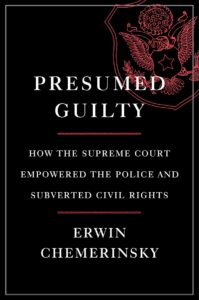
Law professor–and the U.S. Constitution scholar–Erwin Chemerinsky turns the spotlight on police misconduct to the Supreme Court of the United States (SCOTUS). The book underscores the massive role SCOTUS has played in molding police behavior, and how that police behavior has directly led to things such as the chokehold that killed George Floyd in 2020, and the failure to knock-and-announce before entering Breonna Taylor’s home and shooting her. He goes through the four most recent SCOTUS periods–the Earl Warren Court (1953-1969), Warren Burger Court (1969-1986), William Rhenquist Court (1986-2005), John Roberts Court (2005-present) (all named after the presiding chief justice of the Court at that time–and traces how law regarding policing has evolved.
I think this book is for people who seek to understand:
(1) how SCOTUS rulings on the Fourth Amendment, Miranda warnings, eyewitness identification procedures, and remedies for police misconduct have morphed over the decades;
2) how police departments across the nation have directly adopted these rulings or worked around rulings; and
3) how we can enact meaningful police reform moving forward.
The Outline
The preliminaries
- The Framers of the Constitution intended many of its provisions to limit what police can do and to protect all our rights, including those who are suspected and accused of crimes.
- Yet, SCOTUS has done an ineffective job of enforcing those provisions.
- On the contrary, it has consistently empowered police and legitimated the racialized policing that especially harms people of color, even though neither the text of the Constitution nor the Framers’ intent supports these rulings.
- Instead, we must regard the Court’s decisions as a consistent choice to favor the interests of law enforcement over the rights of individuals and to ignore the enormous racism that has infected policing since the nation’s first days.
- SCOTUS develops the law case by case, and the pattern that emerges from the cases is deeply disturbing.
SCOTUS’s essential role in enforcing the U.S. Constitution and controlling the police
- The connection between SCOTUS rulings and police behavior is not always apparent.
- In reality, what the Supreme Court says about the police has an enormous effect.
- Courts are supposed to ensure that other governmental entities follow the Constitution.
- The Framers of the Constitution and the drafters of the Bill of Rights sought to limit government power and protect people from arbitrary actions.
- They included many protections against law enforcement because they knew that people could not trust elected or appointed government officials to be their only safeguard against overzealous police.
- The Fourth Amendment, for example, bars police from engaging in unreasonable searches or arrests.
- SCOTUS’s interpretations of the Constitution create the rules that police must follow in their searches, arrests, interrogations, and procedures.
- The Court has contributed significantly to the problem of policing:
- First, it has narrowed the scope of rights that people have when dealing with the police. If there are no constitutional limits to police power, and politically imposed limits are absent, then police can do whatever they want.
- Second, SCOTUS has restricted the remedies available to those whose constitutional rights have been violated.
- The Court has contributed significantly to the problem of policing:
The Warren Court – finally enforcing constitutional protections and remedies
For many decades, SCOTUS did not interpret the Constitution as granting people much protection against police misconduct. But in 1953, Earl Warren became Chief Justice of SCOTUS, which ushered in a period of remarkable constitutional protections.
Fourth Amendment
- Let’s begin with Mapp v. Ohio. In 1957, three armed Cleveland police officers arrived at Dollree Mapp’s home, having received a tip that Virgil Ogletree was hiding in her house, who was wanted for questioning in a crime. Mapp is an African American woman.
- The officers knocked on the door and demanded to come in; she refused, and the officers forced their way inside.
- The officers looked through her photo album and personal papers. They found four books that were considered obscene, and she was arrested for possessing obscene material and sentenced to prison.
- She sued, arguing that the police were there to look for a man–he could not plausibly have been hiding in places the police searched, like dresser drawers or a suitcase.
- The issue was whether the evidence used against Mapp at trial–the contents of the suitcase–should be excluded because the police search clearly violated the Fourth Amendment’s prohibition of unreasonable searches and its requirement for a valid warrant.
- The Warren Court held that evidence obtained in violation of the Fourth Amendment must be excluded from use at trial regardless of whether the police are federal, state, or local employees.
- Katz v. United States also dramatically increased the protections of the Fourth Amendment.
- In the 1960s, Charles Katz would walk from his building down the street to three public telephone booths. He would enter one booth and make a call, to transmit wagering information. He had no idea that police were listening in on his calls.
- They focused on the phone booths, but they did not get a warrant to listen in on his calls. Katz was arrested for violating federal gambling law. His lawyer moved to suppress the evidence, saying that it was acquired in violation of the Fourth Amendment.
- SCOTUS reversed and overturned earlier precedents, and said that by listening to and recording Katz’s words, the government had violated his privacy, and the fact that they used an electronic device to do this (without penetrating the wall of the booth) did not matter. The Fourth Amendment protects people, not property.
- The disadvantage of Katz is the inherent difficulty in determining when there is a violation: what constitutes a reasonable expectation of privacy and when should courts recognize that a person has a legitimate subjective expectation of privacy?
- Unfortunately, constitutional protections took a step back in Terry v. Ohio.
- In 1963, an officer in Cleveland, Ohio was, in plain clothes, patrolling a downtown space where shoplifting was common.
- He saw two Black men, John Terry and Richard Chilton, walk down the road past some stores. One would walk past stores, walk back, rejoin his companion, and the other would do the same. They did this five or six times.
- The officer suspected the two men of casing a store. He grabbed Terry, spun him around, and felt what seemed to be a pistol. Both were charged with carrying concealed weapons.
- Their lawyers asked the court to exclude the guns from being used as evidence against them on the ground that the frisk violated the Fourth, since the Fourth explicitly requires that all searches be based on probable cause–the men had done nothing but walk down the street in a way that made the officer suspicious, but that is neither a crime nor evidence of a crime.
- Thus, the issue before SCOTUS was whether police can stop and frisk a person without having to meet the Fourth Amendment standard of probable cause.
- The Court said that it needed to balance the interests of law enforcement and public safety against the intrusion a person surfers when being stopped and frisked.
- The proper balance allows police to conduct a reasonable search for weapons.
- In other words, police do not need to have probable cause to seize a person by stopping them. Nor is it required that the officers have probable cause to frisk the person. As long as an officer has reasonable suspicions that the person has committed or might commit a crime, there can be a stop.
- As a matter of constitutional law, this was a terrible decision.
- The Fourth Amendment clearly states that probable cause is the standard for searches and arrests. No one, not even the State of Ohio, claimed that there was probable cause. But the Court never explained why probable cause was insufficient.
- Second, the Court did not define “reasonable suspicion” and it has not since. It has said that reasonable suspicion requires less than probable cause but more than a mere hunch.
- This ambiguity gives officers enormous discretion in deciding whether there is reasonable suspicion, which has opened the door to racialized policing.
- Study after study has shown that Terry has bolstered race-based policing, since police are far more likely to stop and frisk Black and Latino individuals than white individuals.
- Studies have found that the NYPD stopped black drivers 43% more than white drivers relative to their share of the population. The more encounters there are with police, the greater the chance that police violence will occur.
- Terry is thus directly linked to the fact that Black and Latino people are far more likely to die at the hands of police than are white individuals.
Miranda and the right to counsel
- Prior to Miranda v. Arizona in 1966, incriminating statements from a suspect would be admitted into evidence if they were “voluntary.” But determining what was voluntary was difficult.
- In 1963, Ernesto Miranda was arrested in Arizona and taken into custody on suspicion of kidnapping and raping a woman.
- During the interrogation, the officers did not tell him about his Fifth Amendment right against self-incrimination or his Sixth Amendment right to an attorney.
- In the case, SCOTUS said that custodial interrogation is inherently coercive.
- As such, the suspect must be told that he has the right to remain silent, that anything said can be used as evidence against them, that the person has a right to a lawyer, and if the person cannot afford one, the government will provide an attorney.
- If a person says they’re exercising their right to remain silent, questioning must stop. If a person asks for a lawyer, questioning must stop until one is provided. A person could waive these rights, but the burden is on the government to show that there was a knowing and voluntary waiver.
- Contrary to all fears, countless studies showed that reading people their Miranda rights had no effect on the ability of police to gain confessions or of prosecutors to gain convictions.
- First, the warnings likely do not lessen the coercion inherent during police interrogation.
- All studies show that suspects frequently waive their Miranda rights.
- Second, police often circumvent and undermine the warnings.
- If an interrogation occurs before the arrest, no warnings are needed, and the person has no right to counsel if the interrogation occurs before the arrest.
- Third, police know that even if they intentionally violate Miranda and the statements gained are not admissible, the information obtained still can be used in other ways against the suspect, such as to impeach a criminal defendant.
- First, the warnings likely do not lessen the coercion inherent during police interrogation.
- In another critical case, Gideon v. Wainwright in 1963, someone broke into a pool hall and bar in Florida, and stole five dollars and some beer.
- Clarence Earl Gideon was charged with the crime. He was indigent and could not afford a lawyer. He requested that an attorney be appointed to represent him, but the trial court refused. So, he represented himself and lost–eventually, he filed a handwritten petition for SCOTUS review.
- SCOTUS heard his case, and unanimously held that the government is obligated to provide an attorney not only to criminal defendants who face the death penalty, but also to those who face imprisonment.
False eyewitness identifications
- Inaccurate eyewitness identifications have led to many innocent people being convicted for crimes they did not commit–countless studies show that eyewitness identifications, especially of people of a race different from the eyewitness’s own, are often inaccurate.
- In 1967 in United States v. Wade, SCOTUS for the first time provided some protections for criminal suspects subjected to lineups.
- A man was arrested and placed in a lineup, but his attorney had not been allowed to be present.
- At trial, his lawyer said that this violated the Constitution because he had not been informed or allowed to be present, and he moved to exclude the testimony about the lineup and the resulting identification.
- The court denied this motion, and the man was convicted.
- SCOTUS found that conducting the lineup without the presence of a lawyer violated his right to counsel.
- The Court concluded that all criminal defendants are entitled to have their attorney present at lineups that occur after there has been an indictment.
- But by limiting its ruling to post-indictment lineups, the Court gave police an easy way to get around it: just conduct the lineup after someone is arrested but before they are indicted.
- Also, Wade did nothing to limit police use of photo identifications, where police show the witness pictures instead of lineups.
Remedies for police misconduct
- Rights only have meaning if they can be enforced. For instance, the Warren Court in Mapp applied the exclusionary rule to state and local police–this means that police have to comply with the Constitution when gathering evidence.
- The other basic remedy is the ability to sue for money when there are constitutional violations, and to seek injunctions to prevent future violations.
- The federal statute that allows suits against state and local police when they violate the Constitution is 42 U.S. Code Section 1983.
- Following the Civil War, violence against Blacks was rampant.
- In response, Congress adopted the Civil RIghts Act of 1871, Section 1 of which is now embodied in Section 1983.
- The federal statute that allows suits against state and local police when they violate the Constitution is 42 U.S. Code Section 1983.
- The Warren Court dramatically changed the interpretation of this statute.
- A 1961 Warren Court decision, Monroe v. Pape, greatly expanded the scope of Section 1983 by permitting suits both for official government actions that violate the Constitution and for certain unauthorized actions by individual officers.
- Today all constitutional litigation against local governments and state and local government officials is brought under Section 1983.
Retrenchment – the Burger Court
In 1969, Warren Burger became Chief Justice of SCOTUS, and the Burger Court lasted from 1969-1986–it significantly limited constitutional rights regarding policing. Ideologically, the Burger Court swung sharply to the right, and paved the way for the even more conservative Courts that followed.
Fourth Amendment
- For example, United States v. Miller in 1972
- This case expanded police power to gather information about an individual without needing to comply with the requirements of the Fourth Amendment.
- Miller says that when police obtain information that a person has shared with a third party, it is not a search.
- So, any information we share with a third party, no matter how private–what we tell a doctor, or a suicide prevention hotline, or an accountant–is not protected by the Fourth Amendment and can be obtained by police without needing a warrant based on probable cause.
- The courts seriously underestimate how much police can learn from things like phone numbers, email addresses, and websites.
- Yet, because of the Burger Court’s decision, this is still the law: police can obtain our financial records or phone records without needing a warrant.
- The Court also created and expanded exceptions for where police need to get a warrant, like with the automobile exception to the Fourth Amendment.
- This allows the police to basically stop any car at any time and search it.
- This provides that police may search a car without a warrant when they have probable cause that it may contain contraband or evidence of illegal activity.
- The requirement that they get a warrant–that is, prior approval of a judge–doesn’t exist, and if they stop and search a car illegally, they can make up a reason for probable cause, and be almost sure that the evidence will be admitted.
- The kind of chokehold that killed George Floyd in 2020 remains in use in most of the U.S. because of the SCOTUS ruling in City of Los Angeles v. Lyons.
- On October 6, 1976, four L.A. police officers stopped Adolph Lyons, a 24-year-old African American man, for driving with a burned-out taillight.
- The officers ordered him out of his car, they drew guns, and one grabbed his hands and slammed them onto the roof of the car. He complained about the pain, and as a result one officer began to choke him, and injured his larynx.
- (The chokehold forces the body to convulse. So, for the person being choked, the involuntary physical reaction is to struggle, and that causes the police to choke harder.
- The result may be death caused by either cardiac arrest or asphyxiation.)
- Before this incident, 16 men in L.A. had died from police use of the chokehold, almost all African American.
- Lyons sued L.A. for an injunction to stop officers from using the chokehold, except if necessary to protect an officer’s safety.
- The trial judge ruled in his favor and a federal court of appeals agreed.
- But then SCOTUS, in a 5-4 decision, dismissed his lawsuit, and accepted the city’s argument that Lyons lacked standing to sue in federal court because he could not show that he personally was likely to be put in a chokehold by an L.A. officer in the future.
- In other words, a person who has been harmed by an illegal government action cannot sue for an injunction to halt the practice unless the individual can demonstrate that they are personally likely to suffer that specific injury again.
– The impact of this case has been profound.
- Imagine that a police department subjects women to strip searches when they are brought to a jail for minor offenses, like traffic violations.
- A woman who suffered this humiliation could not bring a lawsuit to ask a court to stop this practice because she would not be able to demonstrate that she was likely to be stopped, arrested, and stripped again in the future.
- This case dramatically limited the ability of the federal judiciary to stop police from using unconstitutional and racist practices like the chokehold.
Miranda
- The Burger Court did not overrule Miranda, but consistently chipped away at it.
- In one case, even though the police improperly administered Miranda warnings and gave someone false information about his rights, the Court found that this did not violate the Constitution.
- This encouraged police to give their own version of the warnings, which could be incomplete and even inaccurate.
- When police know that they can get statements unconstitutionally, to be admitted as evidence and used for impeachment purposes, then they have an incentive to ignore Miranda altogether.
- Many police training manuals instruct police to question outside Miranda.
Refusing to check police eyewitness identification procedures
- As discussed earlier, wrongful convictions do happen, and one of the most frequent causes is inaccurate eyewitness identifications.
- The Burger Court weakened the constitutional protections against false eyewitness identifications in two ways: it limited the right to counsel to post-indictment lineups, and it allowed even identifications following very suggestive police procedures to be admitted as evidence.
- Social science research shows that the certainty of an identification is unrelated to its reliability. People are often completely wrong in their identifications but still profess certainty.
- Why has SCOTUS failed to acknowledge this?
- The justices likely minimize the chances that an eyewitness will identify the wrong person, ignoring a bulwark of studies that demonstrate the contrary.
- The Court trusts police to arrest and prosecute the right person.
- Even if police sometimes make mistakes, the Court assumes, witnesses generally are accurate, and if they are not, cross-examining them at trial is adequate to protect the innocent.
- The author fears that the Court’s underlying assumption is that it is more important to convict somebody, even the wrong person, than to leave a crime unsolved.
Remedies for police misconduct
- As you now know, the exclusionary rule is incredibly important. But the Burger Court, with its conservative majority, looked for every occasion to cut back on the exclusionary rule and lessen its application.
- In Segura v. United States in 1984, for instance, it held that evidence does not have to be excluded if there is an independent source for the information, even if the police got information from the independent source by violating the Fourth Amendment.
- To be fair, the Burger Court expanded the ability of people to sue federal officers for monetary damages for violating the Constitution.
- But it also significantly expanded the immunity of government officers from being held liable.
- Additionally, it enlarged people’s ability to sue cities, which is key for holding police accountable.
- But it also imposed restrictions on such suits that, over time, have made it increasingly difficult to succeed in such litigation.
- In its landmark 1971 decision Bivens v. Six Unknown Federal Narcotics Agents, SCOTUS ruled that federal officers who violate constitutional rights can be sued for monetary damages directly under the Constitution.
- But, over the last forty years, SCOTUS has backed away from Bivens and made it very difficult for the public to sue federal officers.
- It is important to remember the role of courts: the judiciary has the authority and the duty to provide remedies to ensure the necessary relief for violations of federal rights.
- Courts traditionally have created remedies in the absence of legislative action, and rights under federal law and the Constitution should be safeguarded and enforced by federal courts.
- The Burger Court also created a new limit, which would grow into a huge obstacle to suing police: the development of immunity law to protect those sued for constitutional violations.
- Judges and prosecutors would have absolute immunity for acts in their official capacities, no matter if they were wrong.
- The Court also found that police officers have absolute immunity when they testify as witnesses, even when they commit perjury and even with their perjured testimony results in the conviction of an innocent person.
- All other government officers (including police, except for their testimony in court), have qualified immunity, a doctrine that has become very important in limiting the ability of the public to bring lawsuits to recover damages against police.
- For a victim to sue a police officer, success depends on overcoming the officer’s claim to qualified immunity, which requires proving that the officer violated clearly established law that every reasonable officer should know.
- So, whether a government official acted intentionally or even maliciously to violate the Constitution is irrelevant: the only question is whether the official violated clearly established law.
- Simply put, the Burger Court was more concerned with protecting officers than with ensuring that injured individuals receive compensation for the wrongs they have suffered.
Empowering Police – the Rehnquist and Roberts Courts
Fourth Amendment
- In Utah v. Strieff in 2016, the issue before SCOTUS was whether the evidence–drugs found on Strieff–had to be excluded from the trial because they were obtained as the direct result of the police officer illegally stopping Strieff in violation of the Fourth Amendment.
- The court held that since there was an outstanding warrant for his arrest, it broke the causal chain between the unconstitutional stop and the search. That is, the stop’s unlawfulness was irrelevant.
- This ruling greatly incentivizes police to illegally stop individuals, knowing that if an outstanding arrest warrant surfaces, they can search, and anything they find will be admissible as evidence. Outstanding warrants are surprisingly common, especially for traffic tickets.
- This ruling significantly expanded police power and eroded citizen’s rights.
- The Rehnquist and Roberts Courts have also made it easy for police to stop virtually anyone at any time. For instance, in Whren v. United States in 1996:
- If officers follow any car long enough, they will see a driver violate a traffic law, such as changing lanes without a signal, or exceeding the speed limit.
- Once police pull the car over, they can order the driver and passenger out of the car, and search the passenger area of the car and all containers within it.
- It doesn’t matter if the officer’s actual motivation for the stop had nothing to do with traffic enforcement.
- The officer can also formally arrest the person stopped for the traffic infraction.
- Once arrested, the police can search them.
- If they find nothing, the person can be given a traffic ticket and go.
- Anything they obtain that is evidence of a crime can be used against the person.
- Once they arrest a person, they can impound the car and search the entire vehicle.
- Once arrested, the police can search them.
- Whren opened the door to the police being able to stop any vehicle if they observe even the most trivial of traffic offenses, and once stopped, the police have broad powers to search and arrest.
Miranda
- The Rehnquist and especially the Roberts Courts have gone much further in lessening constitutional protections for this fundamental right.
- Many in law enforcement see Miranda as helpful to police, because giving the warnings and getting a waiver has generally produced a virtual ticket of admissibility.
- Suspects often do not understand the warnings, and just reading the warnings does not reduce the inherent coercion of a police interrogation.
- And, silence isn’t enough to invoke the right to remain silent–rather, you have to make an “unambiguous” invocation of this right.
Remedies for police misconduct
- For the first time in history, the Court concluded that the exclusionary rule does not apply if police violate the Fourth Amendment by good faith or even negligent actions.
- The Court made it even harder to prove a municipal policy and hold governments liable for their constitutional violations.
- Even in the rare instance in which officers are sued, they can assert an “immunity defense,” and this will very often leave a person injured by police misconduct without any means of recovery.
- All these decisions about immunity are part of a larger trend that began when Ronald Reagan was president in the early 1980s, and supported using force to combat crime.
- The Court’s doctrine that police liability requires the existence of a prior case with virtually identical facts means that officers are almost always protected by qualified immunity.
- The Rehnquist and Roberts courts can be easily summarized: the police almost always win. Putting all this together, it is clear that the Supreme Court has contributed enormously to the problem of policing in the U.S.
The path to meaningful police reform
- These are policy changes that police departments, as well as state and local governments, can use to enact meaningful police reform:
- Eliminate stops and frisks that are based on reasonable suspicion, and instead require that all seizures, arrests, and searches be based on probable cause;
- Require written consent for police searches;
- Restore people’s ability to raise Fourth Amendment claims on habeas corpus;
- Get rid of pretextual police stops, and exclude evidence gained as a result of illegal stops;
- Provide counsel for everyone being interrogated by police;
- Eliminate the requirement that a suspect must expressly state the right to remain silent or the right to counsel;
- Allow counsel at all identification procedures;
- Eliminate the most suggestive forms of police identification;
- Exclude suggestive eyewitness identifications from being heard by juries;
- Strengthen the exclusionary rule when police violate the Constitution so that any evidence gained as a result of unconstitutional behavior cannot be used at trial;
- Expand the civil liability of police officers who violate the Constitution and that of the cities that employ them;
- Eliminate dangerous police practices, such as the use of the chokehold and “no knock” warrants.
- Mandate data collection about policing;
- Increase transparency as to policing.
- Meaningful police reform will lead to better changes than abolishing the police.
- Abolishing the police will not end policing–it will just lead to the establishment of private police.
- So, those wealthy enough to pay for protection will create a private structure that will likely be even more regressive because they do not have to comply with the Constitution. This would result in a new inequity.
- Strengthen state constitutions, because if a state supreme court explicitly says that it is relying on state constitutional law for its decision and there is no federal issue, then SCOTUS cannot touch the state court’s ruling at all.
And More, Including:
- Why SCOTUS ignored policing for much of U.S. history
- Details about many of the justices, the makeup of the Supreme Court, and how politics and nominations came to change so much of policing in the United States
- Stone v. Powell and the change in habeas corpus (legal petition that a person can file in court if they claim to be illegally detained or imprisoned by the government)
- Extensive details on each legislative reform and why they are needed
- Data on how African Americans and Hispanics are more likely to be stopped by police than whites for the same behavior, more likely to be arrested, and more likely to be subjected to police violence
- How a “code of silence” in police departments prevents police officers from reporting misconduct
- Why suspects consent so often, even when they have contraband with them
Presumed Guilty: How the Supreme Court Empowered the Police and Subverted Civil Rights
Author: Erwin Chemerinsky
Publisher: Liveright Publishing Corporation
384 pages | 2022
Purchase
[If you purchase anything from Bookshop via this link, I get a small percentage at no cost to you.]