The Non-fiction Feature
Also in Bulletin #49:
The Fiction Spot: 2054 by Elliot Ackerman & Admiral James Stavridis
The Product Spot: NatGeo Geography page
The Pithy Take & Who Benefits
Journalist Tim Marshall takes us on a tour of the world’s geopolitics–specifically, how does a country’s geography shape what it has become, and how does that geography push its political decisions today? Because although critical decisions are surely made due to pressures from peoples and cultures and economies, all those factors ultimately sit within the context of geography, which can uplift or hem in a country.
I think this book is for people who seek to understand:
(1) background on how the geographies of certain countries have shaped political decision-making in those countries;
2) how the USA and China have loudly and quietly been seeking power throughout the world, using geographies to their advantage; and
3) how the decisions that colonial powers made decades ago have directly led to fighting and instability in certain countries today.
The Outline
The preliminaries
- The land that we live on has always shaped us. It has shaped the politics, societal development, and economies of virtually everyone in the world.
- Geopolitics examines international affairs through the lens of geography; so, not just physical landscapes and features (such as mountains and rivers), but also climate, demographics, and access to natural resources.
Russia
- Russia, the largest country in the world, is enormous.
- It is six million square miles and eleven time zones.
- “Russia” as an idea dates back to the 9th century.
- It began as a loose federation of East Slavic tribes.
- The first Tsar, Ivan the Terrible, used the concept of attack as defense–beginning expansion by consolidating at home and then expanding outwards.
- In the 20th century, communist Russia created the Soviet Union.
- After WWII, it stretched from the Pacific to Berlin and from the Arctic to the borders of Afghanistan; it was a massive superpower, rivalled only by the USA.
- But, its population is quite small, at only 144 million. Plus, its agricultural growing season is short, and it struggles to distribute what is grown, since the country is so large.
- Since the 1990s, Russia has nervously watched NATO creep closer and add countries that Russia claims it was promised would not be joining, such as the Czech Republic, Hungary and Poland, Bulgaria, Estonia, Latvia, Lithuania, Romania, Slovakia, and Albania.
- And although 75% of Russia’s territory is in Asia, only 22% of its population lives there.
- As one moves beyond the Russian heartland, much of the population is not ethnically Russian and pays little allegiance to it, which results in an aggressive security system.
- What Russia desperately wants is a warm-water port where the water doesn’t freeze in the winter, which would allow them access to the world’s major trading routes.
- Frozen ports are bad: they not only prevent trade, but they also prevent the Russian fleet from expanding into a global power.
- Lack of a warm-water port puts Russia at a geographical disadvantage, but it is saved from being a much weaker power because of its oil and gas reserves.
- Russia is second only to the USA as the world’s biggest supplier of natural gas.
- Several European countries, including Germany, rely on Russian energy heavily.
- As such, energy as political power will be deployed time and again in the coming years–it is one of Russia’s most powerful weapons.
- The better your relations with Russia, the less you pay.
- Reliant countries are trying to wean themselves off Russian energy.
- This is an economic geographic battle, and one of the modern examples where technology is utilized in an attempt to beat the geographic restraints of earlier eras.
- As such, energy as political power will be deployed time and again in the coming years–it is one of Russia’s most powerful weapons.
- Russia still faces many challenges.
- Its sharp population decline has stopped for now, but still remains a huge problem.
- The average lifespan for a Russian man is below 65, which is quite low.
China
- As with Russia, the concept of China as an entity began long ago–almost 4,000 years.
- Chinese civilization began in what is now known as the North China Plain, which is a large tract of nearly 160,000 square miles, and around the Yellow River Basin and down past the Yangtze River.
- The plain is fertile, and the climate allows rice and soybeans to be harvested twice a season, which encourages rapid population growth.
- The Yellow River is where the Chinese learned to farm, and make paper and gunpowder.
- To the north is the harsh Gobi Desert (currently Mongolia), and to the west is the Tibetan Plateau, reaching to the Himalayas. To the southeast and south is the sea.
- Chinese civilization began in what is now known as the North China Plain, which is a large tract of nearly 160,000 square miles, and around the Yellow River Basin and down past the Yangtze River.
- By 1500 BCE, mini city-states emerged, forming the Shang Dynasty, and this was the beginning of the Han people.
- The Han now make up over 90% of China’s population.
- In the 1800s and 1900s, the imperial powers, such as Britain, arrived and carved up the country.
- It was, and is, one of the greatest humiliations the Chinese have suffered.
- This is a narrative the Chinese Communist Party regularly uses; although it is partly true, it also covers up the Party’s own failures and policies.
- After this period, nationalist forces under Chiang Kai-shek and Communist armies under Mao Zedong battled for supremacy until 1949, when the Communists won and the Nationalists withdrew to Taiwan.
- Mao centralized power in a way that was never before done.
- In the early 1980s, China was rising economically and militarily.
- By the end of the 1990s, it had recovered from the Tiananmen Square massacre of 1989, regained Hong Kong and Macau from the British and Portuguese, respectively, and it began to reassess its security and plans to move out into the world.
- By looking at China’s modern borders, we can tell that it is a great power confident that it is secured by strong geographical features, which allows China to be effective in defense and trade.
- This helps explain Tibet and its importance to China–the geopolitics of fear.
- The Himalayas run up and down the Chinese-Indian border. If China did not control Tibet, India might, which would give India the massive heights of the Tibetan Plateau and allow them to push into the Chinese heartland.
- This helps explain Tibet and its importance to China–the geopolitics of fear.
- Xinjiang
- Xinjiang is a semi-autonomous Chinese province.
- During the inter-ethnic rioting in 2009, over 200 people died. Beijing responded in three main ways:
- Ruthlessly suppressing dissent;
- Pouring money into the region;
- Pouring in Han Chinese workers.
- Xinjiang is too strategically important to allow a revolution like this to get off the ground; it borders eight countries (thus buffering the heartland), has oil, and is where China’s nuclear weapons testing sites are.
- Taiwan
- China claims Taiwan as its 23rd province, but Taiwan is allied with the USA and is armed to the teeth.
- The Chinese are set on having Taiwan but cannot challenge for it militarily; instead, they press on their soft power by increasing trade and tourism between the two.
- China’s navy and expansion
- China is building its navy and intends to become a two-ocean power (Pacific and Indian).
- It’s been investing in ports in Burma, Bangladesh, Pakistan, and Sri Lanka.
- China is able to expand so rapidly because it is not weighed down diplomatically or economically by human rights.
- If it can avoid a major conflict with the USA or Japan, the only real threat to China is itself.
USA
- The USA’s geography is vast and varied.
- There is the East Coast Plain that leads to the Appalachian Mountains, which is watered by short but navigable rivers, and home to fertile soil.
- Moving west, there are the Great Plains that stretch to the Rocky Mountains, coupled with the Mississippi basin that flows into the Gulf of Mexico.
- This basin has more miles of navigable river than the rest of the world put together.
- Rivers are a natural conduit for trade, and are much cheaper than road travel.
- Past the Rockies is the desert, the Sierra Nevada Mountains, a coastal plain, and the Pacific.
- In the north, above the Great Lakes, is the Canadian Shield, which essentially bars human settlement; to the southwest is the desert.
- Being sandwiched between the large land masses of Canada and Mexico is also an asset, since any hostile power attempting to invade would have to go through those countries, and would need to have an incredibly long supply chain.
- So, the USA has strategic geographical depth, massive fertile land, and an enormous number of expanding trade routes.
- After WWII, the USA was the last country standing–the Europeans had exhausted themselves and their homes were in ruin, the Japanese were crushed, and the Chinese devastated, and the Russians weren’t in the capitalist game.
- The USA began projecting their vast power into the world, and staying there.
- As the world’s largest economic and military post-war power, the USA needed to control the world’s sea routes.
- The USA has been investing time and money in East Asia.
- Americans pushed the door open for relations with Japan, Thailand, Vietnam, South Korea, Singapore, Malaysia, Indonesia and others–although they all may have issues with each other, those issues are dwarfed by the knowledge that if they do not stick together with the USA by their side, they will eventually fall to China.
- Only time will tell how the Chinese, Americans, and others in the region manage each crisis in ways that allow them to save face, and prevent them from building up resentment and anger.
- As for nation building, that phase appears to be over.
- In Iraq, Afghanistan, and elsewhere, the USA repeatedly underestimated the mentality and strength of small powers and tribes.
- Last, in a projection of what is to come, due to offshore drilling and underground fracking in the country, the USA seems destined to become not just self-sufficient in energy, but a net exporter of energy.
Western Europe
- Western Europe’s climate, buffered by the Gulf Stream, gifted the region with fertile soil and the right amount of rain to cultivate crops on a large scale.
- This led to population growth where work was possible all year round, and temperatures warm enough to work in, and then cold enough to kill off many germs.
- Bountiful harvests meant extra food to be traded, which also led to trading centers.
- Additionally, rivers are long and navigable, which was perfect for trade. They flowed in many directions, into oceans and seas, with natural harbors.
- These factors led the Europeans to creating the first industrialized nation states, which also led to them being the first to create industrial-scale war.
- Europe remains divided between its geographical and linguistic regions.
- Its major rivers do not meet, which partly explains why there are so many countries in a fairly small space.
- The rivers acted as boundaries, creating between them spheres of economic influence.
- The EU and NATO countries feel the increasing pressure to present a united front to new challenges, and much of this presentation relies on a key relationship in the EU: France and Germany.
- France
- Of all the countries on the North European Plain, France is the best situated.
- It’s the only country that is a northern and southern power–it contains the largest expanse of fertile land in Western Europe.
- Germany
- Germany has always had bigger geographical problems than France.
- The flatlands of the North European Plain give it two reasons to fear: to the west are the French, and to the east are the Russians.
- The ultimate fear is a simultaneous attack by the two of them.
- But now, Germany is Europe’s indispensable power.
- Economically, it is unrivaled.
- France
- The UK inserts itself when it can between Franco-German alliances, and when it can’t do that, it seeks to ally itself with other, smaller member states.
- Geographically, the UK is solid: good farmland, decent rivers, access to the sea and fish, and close enough to everyone else to trade, but protected by virtue of being an island.
- The water around the island, and the trees upon it that allowed a great navy to be built, in addition to the economic conditions that sparked the Industrial Revolution, all led to the UK leading a global empire.
- The Euro
- 19 out of the 28 countries in Western Europe joined for a single currency–the Euro. Unfortunately, many countries that joined were not ready.
- They were all supposed to have certain levels of debt, unemployment, and inflation.
- But some, like Greece, fudged the books. So, when the economic crisis of 2008 hit, wealthier countries had to bail out poorer ones, and a bitter domestic row broke out.
- Forty years after joining the EU, the British left, mainly due to concerns about sovereignty and immigration–these themes and worries will play out over the next few decades for many Western European countries.
Africa
- Africa is a huge continent–you could fit the USA, Greenland, India, China, Spain, France, Germany, the UK, and most of Eastern Europe into Africa.
- Africa’s coastline is beautiful, but has terrible natural harbors.
- Its rivers are incredible, but since there are so many waterfalls, they are similarly terrible for transportation.
- The top third of Africa begins on the Mediterranean coastlines of the North African Arabic-speaking countries.
- This then becomes the Sahara, the world’s largest dry desert, which is almost as big as the USA.
- To the east are the great lakes of Uganda and Tanzania, and to the west there are more deserts in Angola and Namibia.
- Going further down to South Africa, the climate is Mediterranean.
- Much of the plant and animal life are unwilling to be domesticated.
- The continent’s rivers are a drawback, and have hindered contact and trade between regions, which hindered the formation of large trading regions and affected economic development.
- That is, the continent’s giant rivers–the Niger, the Congo, the Zambezi, and the Nile–don’t connect.
- This, among other things, led to thousands of languages existing in Africa, with no overarching cohesive culture.
- Over the decades, European power drew lines on Africa’s map.
- The lines had everything to do with what the powers wanted, rather than what the people living on the maps felt themselves to be, or how they wanted to organize themselves.
- Currently, many Africans are partially the prisoners of the political geography of the lines that Europeans drew long ago, and of the natural barriers that nature established.
- Egypt
- Modern Egypt is now the most powerful armed force of all the Arab states due to American military aid, though it is still constrained by deserts and the sea.
- Nigeria is sub-Saharan Africa’s largest producer of oil.
- By size, population (177 million), and natural resources, Nigeria is West Africa’s most powerful country.
- The Chinese are also everywhere in Africa–about ⅓ of China’s oil imports are from Africa, and many precious metals.
- For instance, China is building a $14 billion rail project to connect Mombasa to Nairobi.
- Chinese investment is palatable to many African governments, since they don’t ask difficult questions about human rights or demand economic reform; China’s presence in Africa is here to stay, and to expand.
The Middle East
- The Middle East extends across 1,000 miles, east to west, from the Mediterranean Sea to the Iranian mountains.
- From north to south, it is 2,000 miles long, and includes deserts, oases, mountains, rivers, great cities, and plains.
- It has a great deal of natural wealth in oil and gas.
- It also has the fertile region known as Mesopotamia.
- The Ottoman Empire (1299-1922) ruled from Istanbul.
- As it began to collapse, in 1916, a British diplomat named Colonel Sir Mark Sykes drew a line across a map of the Middle East from Haifa (what is now Israel) to Kirkuk (what is now Iraq).
- His French counterpart, Francois Georges-Picot, took land north of the line–Sykes took south of the line.
- The term “Sykes-Picot” became shorthand for the many decisions made during this time that betrayed promises given to tribal leaders, and as with what Europeans did in Africa, partially explain the unrest and extremism of today.
- That is, arbitrarily creating “nations” out of people unused to living together in one region will not lead to justice, equality, or stability.
- In recent decades, because the Arab states have not experienced a true opening-up to the world, and have suffered deeply from colonialism, they were not ready to turn the Arab uprisings into a real Arab spring.
- The Arab Spring is a misnomer invented by the media, and it clouds our understanding of what was truly happening.
- Too many reporters rushed to speak to young liberals, and mistook them for the opinion of the majority.
- Power
- In the Middle East, power flows from the barrel of a gun.
- For example, Iraq: it is a democracy in name only and is definitely not liberal (people are routinely murdered for being gay).
- The second phase of the Arab uprising is taking place.
- It is at a complex intersection of social norms, religious beliefs, and tribal connections are much more powerful than abstract “western” ideals of equality, freedom of expression, and universal suffrage.
- The Arab countries are embedded with prejudices, and often hatreds.
- Liberal democracies don’t stand a chance, not because the people of the region are radical; but because if you are hungry and frightened, and you are offered either bread and security or the concept of democracy, you choose bread and security.
India and Pakistan
- Indian and Pakistan share a 1,900-mile long border, and neither wants the other around.
- India’s population is near 1.3 billion, while Pakistan’s is 182 million.
- They are tied together by geography–the Bay of Bengal, the Indian Ocean, and the Arabian Sea are to the southeast, south, and southwest; the Hindu Kush to the northwest and the Himalayas to the north.
- The plateau of the Baluchistan Desert then turns into the mountains of the Northwest Frontier, which rise even higher to become the Hindu Kush.
- To the east there is the Karakoram Range, which leads to the Himalayas. From here is the border with China, all the way to Burma, and then where Indian curves around Bangladesh.
- In the late 1940s, the forces of postcolonial nationalism and religious separatism split this area into three major pieces: India, Pakistan, and Bangladesh.
- India has no real center: the region has always been divided by the ancient distinctions of the languages Punjab and Gujarat, the mountains and the deserts, and the religions Islam and Hinduism.
- Pakistan does not have as strong a national identity as India does.
- The relationship between the two will never be friendly, but if it weren’t for Kashmir, they could potentially be cordial.
- If India had full control of Kashmir, it would give India a window into Central Asia and a border with Afghanistan. It would also deprive Pakistan of a border with China, and diminish the strength of a Chinese-Pakistani relationship.
- India may soon rival China as an economic powerhouse this century, and it also has 9,000 miles of internal navigable waterways and huge areas of arable land.
- It has also strengthened its ties with Burma, the Philippines, and Thailand–it is also working with Vietnam and Japan to check China’s growing domination of the South China Sea.
Korea and Japan
- North and South Korea
- North Korea is a poverty-stricken country with about 25 million people, led by a Communist monarchy and supported by China (partly out of fear that, if they don’t, millions of refugees will flood north).
- Total state control in North Korea has resulted in beatings, torture, prison camps, and extrajudicial murder.
- It has a huge armed forces, of almost a million people, though they are not highly trained.
- South Korea, with mixed feelings about risking its prosperity, does little to advance reunification.
- With open water to its west, east, and south, and few natural resources, South Korea has taken care to build a modern navy. It keeps a close eye on the sea lanes of the entire region.
- It has been investing diplomatic capital in closer relations with Russia and China.
- The entire region from Malaysia to Russia eyes the North/South Korean problem nervously.
- It has the potential to blow up spectacularly, dragging in other countries and damaging economies and people.
- China doesn’t want to fight for North Korea, but they also don’t want a united Korea, with American bases, close to their border.
- The Americans also don’t want to fight for the South Koreans, but they also can’t be seen as giving up on a friend.
- North Korea is a poverty-stricken country with about 25 million people, led by a Communist monarchy and supported by China (partly out of fear that, if they don’t, millions of refugees will flood north).
- Japan’s history is very different, in part due to its geography.
- The majority of its 127 million population live on four large islands that face the Koreas and Russia.
- They have become a strong maritime people.
- Japan has few natural resources–limited and poor-quality supplies of coal, little oil, and a shortage of many metals.
- Japan worries about China, which is why it keeps close to the USA diplomatically and militarily.
Latin America
- The limitations of Latin America’s geography have been compounded by the way its nation states were created.
- In the Old World culture that dominated the area for decades, there were powerful landowners and serfs, which led to inequality.
- European settlers also imposed a geographical problem that hampers development to this day: they stayed near the coasts, where things developed, and the inland did not.
- That is, the interior is very sparsely populated–South America is a demographically hollow continent and its coastline is often referred to as the populated rim.
- Mexico
- It is growing into a regional power, but it will always have desert wastelands to the north, mountains to the east and west, and jungles to the south, all of which limit its economic growth.
- Mexico lacks a navy that can secure the Gulf of Mexico, and relies on the US navy to ensure the sea lanes remain open and safe.
- The Mexican border has always been a haven for smugglers, but this has become even more true in the last few decades, as a result of the USA’s policies.
- In the 1970s, President Nixon declared a “War on Drugs,” and in the early 1990s, Washington took the war directly to the Colombian drug cartels with overt assistance to the Colombian government.
- In response, the cartels created a land route up through Central America and Mexico, and into the American Southwest.
- This led to Mexican drug gangs trying to manufacture their own drugs and facilitate their own routes.
- Central America
- It’s a hill country with deep valleys and has the Andes, which is the longest continuous mountain chain in the world. They are mostly impassable, and cut many regions in the west off from the east.
- The population is more equally distributed across the land, compared to South America.
- Brazil
- Brazil dominates the eastern side of Latin America with the Amazon river, which is the second-longest in the world.
- As a whole, the Latin American countries do not have a natural affinity with the USA.
- The USA has been orchestrating events in Latin America for decades, and the end results have not always been positive for Latin Americans.
- This coldness means that when the Chinese arrived, doors opened–China now sells or donates arms to Uruguay, Colombia, Chile, Mexico, and Peru.
The Arctic
- The Arctic Ocean is 5.4 million square miles, making it almost as big as Russia.
- The Arctic region includes land in parts of Canada, Finland, Greenland, Iceland, Norway, Russia, Sweden, and the USA.
- It is vast expanses of rock with freezing winds, spectacular fjords, polar deserts, and even rivers.
- The effects of global warming on the Arctic are more apparent than ever: ice is melting, which allows easier access to the region; plus, energy deposits have been discovered, which has shifted the diplomatic strategies of this region.
- There is an estimated 1,600 trillion cubic feet of natural gas, 44 billion barrels of natural gas liquids, and 90 billion barrels of oil in the Arctic, most of it offshore.
- There are also extra reserves of gold, zinc, nickel, and iron.
- ExxonMobil and Shell and other energy giants have already begun exploratory drilling.
- Polar bears and arctic foxes are beginning to move, as are walruses and fish. As fish migrate, they deplete stocks for some countries but populate others.
- There are multiple legal disputes over sovereignty in the Arctic Ocean, many with the potential to cause serious tension.
- These issues stem from the same desires and fears: the desire to safeguard routes for military and commercial shipping, as well as own the natural riches of the region, coupled with the fear that others may get to it before you do.
- It is worth bearing in mind that there are 5.5 million square miles of ocean in the Arctic, where it is dark, dangerous, and deadly.
- For anyone to succeed in the region, countries will need to cooperate, especially on things like fishing stocks, smuggling, terrorism, environmental disasters, and search and rescue.
Space
- More recently, countries have been venturing into space. Satellites have been linking humanity forwards toward a more collective and cooperative future, but countries also use them to spy on other countries.
- The USA and China have missile systems that can operate in space.
- As we venture forth into this new territory, it is critical to remember that we are, in many ways, still imprisoned by our own minds, confined by our suspicion of the “other,” and hemmed in by our primal competition for resources.
And More, Including:
- The neutral, pro-Western, and pro-Russian countries that came into being after the Soviet Union broke apart
- The challenges confronting China and its ability to feed the population, since more than 40% of arable land is either polluted or has thinning topsoil
- One of the biggest failures of European line-drawing in Africa–the Democratic Republic of the Congo–and how it has led to some of the deadliest conflicts on the world
- Background on Syria and Israel-Palestine (though much, much has changed since this book was published)
- Latin America’s attempts to create a cohesive union
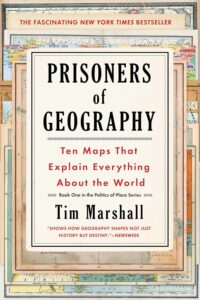
Prisoners of Geography: Ten Maps that Explain Everything about the World
Author: Tim Marshall
Publisher: Scribner
464 pages | 2016
Purchase
[If you purchase anything from Bookshop via this link, I get a small percentage at no cost to you.]