The Non-fiction Feature
Also in Bulletin #46:
The Memoir Spot: The Management Myth by Matthew Stewart
The Product Spot: ProPublica – McKinsey’s Rules
The Pithy Take & Who Benefits
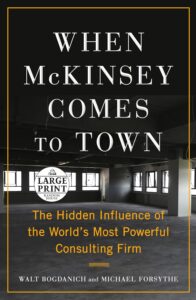
When McKinsey Comes to Town, written by journalists Walt Bogdanich and Michael Forsythe, is a damning look into one of the world’s most secretive and incredibly influential actors–the management consulting firm, McKinsey. In writing this book, the authors interviewed nearly one hundred current and former McKinsey employees, who chose to speak not because they were disloyal, but because they were exactly the types of people McKinsey seeks to hire: highly intelligent people of principle.
I think this book is for people who seek to understand:
(1) just how many industries McKinsey has consulted for–many of which have likely touched your life–from car manufacturers to cigarette companies to insurance to government entities;
(2) McKinsey’s growing foray into advising authoritarian governments like Saudi Arabia and China; and
(3) how McKinsey escapes the disastrous consequences of many of their decisions, even when their clients do not.
The Outline
The preliminaries
- McKinsey is one of the most elite management consultancy firms in the world, with around 34,000 employees.
- McKinsey does not identify clients or disclose the advice it gives, which means that people all over the world are largely unaware of the firm’s profound influence.
- McKinsey has very likely affected your life, from the cost and quality of your medical care, to how schools and governments function.
- The firm has advised almost every major pharmaceutical company and their government regulators, as well as health insurers, airlines, universities, museums, weapons makers, private equity firms, casinos, bookmakers, professional sports teams, media companies, the Obama administration, and the Trump administration.
- McKinsey’s earnings allows the firm to run a private hedge fund, with large parts of its roughly $31.5 billion in assets under management concealed on an island tax haven in the English Channel.
- In 2018, ProPublica, The New York Times, and other media began diving into the firm’s affairs, discovering that the iconic management company has done a vast array of questionable acts.
Winners and Losers – The Inequality Machine
- In 1950, General Motors and the United Auto Workers reached a momentous labor agreement.
- GM executives began wondering if they were getting paid enough, and asked McKinsey to conduct a study of executive pay.
- McKinsey found that worker wages were rising faster than executive compensation.
- This enormously significant study spawned one of today’s most politically charged issues: income and wealth inequality.
- In 1950, a CEO of a large company made around 20x a production worker’s income. By 2020, it was at least 351x as much.
- This study ignited the corporate executive race to the top, and the study made it easier for corporate directors to approve higher compensation.
- They said that corporations that paid bonuses produced twice the profits of companies that didn’t and they began layering pay packages with profit sharing and stock awards.
- This study, and McKinsey’s general consulting for corporations, untethered executives from being loyal to particular industries or companies, and instead tied them to management in general.
- This led executives to embrace the one thing common to all corporations: making money for shareholders.
- To create an “outstanding corporation,” managers had to keep their stock price high, and cutting costs through layoffs was usually easier and quicker than boosting revenue–McKinsey may be the single greatest legitimizer of mass layoffs in modern history.
- CEOs benefited from higher stock prices in part because their income was largely tied to the value of that stock.
- With no loyalty to workers, corporate executives began outsourcing good, middle-class jobs to countries where wages were lower.
Playing Both Sides – Helping Government Help McKinsey
- In the 1990s, the Illinois governor allowed McKinsey to study poverty programs, set goals, and measure progress. McKinsey did everything pro bono, and the study resulted in real change in 1997 when a new law reorganized health services in the state.
- Specifically, the state privatized Medicaid services, and later officials wanted to expand the program by enrolling an additional 650,000 people, but they needed McKinsey’s help to do so.
- During this time, Illinois comptroller Susana Mendoza realized that hospitals were suffering from budget cuts.
- She discovered that Illinois officials were quietly shoveling millions of dollars to McKinsey consultants, often done without legislative oversight or approval.
- Mendoza did not realize the larger story she was helping uncover–how the government became an accomplice in McKinsey’s effort to build a health-care empire around the idea of playing all sides of the game.
- In recent years, McKinsey billed managed care companies more than $200 million, making it one of the firm’s most lucrative sectors.
- Moreover, four of the seven companies that were part of a $63 billion Medicaid contract from Illinois, where McKinsey advised Illinois, were later acquired by McKinsey clients.
- McKinsey’s healthcare team also played an important role in the debate over President Obama’s Affordable Care Act.
- McKinsey released a survey that projected that almost ⅓ of employers “definitely or probably” would stop offering health coverage when the law took effect.
- This was significantly out of sync with other assessments, which alarmed officials. Multiple legislative committees demanded that McKinsey produce more information regarding the survey. McKinsey finally conceded that its survey was not comparable to other, more rigorous studies.
- At that time, Democrats did not know why McKinsey issued that survey, or how close they were to health insurers, or they might have done a lot more.
- McKinsey’s four biggest individual donors to political campaigns were leading healthcare consultants.
- McKinsey nabbed around $77 million in FDA business under the Trump administration (which was more than what they nabbed under the Obama administration).
- McKinsey has also advised at least 19 drug companies–all subject to FDA regulation–and three major drug distributors, for which it billed a grand total of at least $400 million during a recent three-year period.
- McKinsey sought people who could help drug companies escape trouble.
- During the Obama and Trump administrations, McKinsey won over $1 billion in federal contracts, without competition.
McKinsey at ICE
- ICE is U.S. Immigration and Customs Enforcement, the federal agency responsible for finding undocumented immigrants and deporting them.
- The Trump administration awarded McKinsey dozens of consulting contracts, including ones with ICE.
- McKinsey recommended that ICE spend less on food, medical care, and supervision of detainees.
- These proposals alarmed even some ICE officials, who questioned whether the cuts justified the human cost.
- McKinsey helped ICE carry out Trump’s immigration policy, full stop.
- Despite ICE’s reputation, key people there actually wanted to improve the quality of life for detainees, and they fought against McKinsey’s suggestions.
Befriending China’s Government
- China has essential “central enterprises” that are critical to maintaining the communist state – McKinsey has advised at least 26 of the 96 central enterprises.
- For instance, McKinsey landed China Communications as a client, which was huge.
- From the U.S. perspective, when China Communications built an island in the Pacific, it fundamentally altered the global balance of power.
- These days, U.S. warships that pass close to the new islands are harassed by Chinese navy vessels and auxiliary ships, vastly increasing the likelihood of a deadly mishap between the two countries.
- At the same time, McKinsey has taken hundreds of millions of dollars from the U.S. Defense Department and the Pentagon–McKinsey advises both the U.S. government and Chinese government on similar issues at the same time.
- By dispensing advice to state-owned companies such as China Communications, McKinsey bolsters the power of the ruling Communist Party.
Guarding the Gates of Hades – Tobacco and Vaping
- For over 50 years, the cigarette industry deceived the public to escape accountability for selling one of the most lethal consumer products in U.S. history.
- McKinsey, for decades, had helped tobacco companies do this. McKinsey knew of the health risk, since it recommended that some of the companies coordinate research on the problem of smoking and health, and to study the physiological effects of smoking.
- As warnings about cigarettes intensified, McKinsey took on new tobacco clients.
- As the anti-smoking movement grew in the U.S., cigarette companies worried that the sentiment would spread to other countries, so McKinsey helped revitalize cigarette brands in those countries.
- McKinsey also worked with the FDA, which began regulating tobacco products in the 2000s.
- Since then, the FDA awarded McKinsey more than $11 million for advice on regulating tobacco. At the same time, McKinsey consulted for the world’s largest cigarette companies and did not disclose the potential conflict of interest.
- As vaping gained popularity, McKinsey consulted for Juul on things such as which flavor names would most appeal to 13- to 17-year-olds, and helped Juul write their FDA submission.
Turbocharging opioid sales
- One way McKinsey drums up new business is by writing “thought pieces” that suggest that certain companies have problems that need fixing, and then suggesting that McKinsey has the fix.
- They wrote such an article about drug companies, arguing that they should target physicians who are most likely to prescribe more of a drug over time.
- Purdue Pharma liked this line of reasoning, and paid millions to stoke the nation’s appetite for OxyContin.
- As Purdue came under scrutiny, McKinsey helped protect its opioid franchise.
- McKinsey also advised Johnson & Johnson, recommending that it target high-abuse-risk patients, and move physicians who were “stuck” in prescribing less potent opioids into prescribing stronger formulations.
- Next, McKinsey also helped the drug companies deal with retail pharmacies.
- For instance, Walgreens had new safeguards to flag suspicious patients and impose dose limits.
- McKinsey suggested lobbying Walgreens leaders to loosen these safeguards, or to create an alternative drug delivery system to get around them.
- In July 2013, it presented an analysis to “turbocharge” opioid sales to the Sackler family, who owned Purdue.
- The main takeaway from that analysis is that while drug stores and law enforcement officials were trying to limit the rush of opioids coursing through the country, McKinsey was doing the opposite–actively seeking ways to get around those safety measures.
- During this time, the FDA, the agency responsible for ensuring the safety of the country’s drug supply, awarded McKinsey a $2.6 million consulting contract with the Center for Drug Evaluation and Research, which regulates prescription and generic drugs.
Allstate’s Secret Slides
- When Allstate started, in the 1950s, it would pay out the vast majority of its premium income in claims, usually making a modest profit.
- Decades later, during a Florida court case, one attorney found out that McKinsey, in a secret slide deck, gave advice to Allstate about how to overhaul its claims system.
- The Florida insurance commissioner began investigating. Allstate refused to comply, the commissioner suspended Allstate’s license, and finally Allstate handed over the slides.
- The slides revealed that Allstate’s prior model had changed after a meeting with McKinsey in the 1990s.
- McKinsey told Allstate to settle 90% of its claims as quickly and as cheaply as possible.
- For the other 10%, those who didn’t take the offer, the “boxing gloves” treatment was needed: fighting in courts, wearing people down.
- McKinsey also designed a system called the Claims Core Process Redesign that pushed adjusters to make quick, lowball offers, rather than coming up with fair settlements.
- Essentially, McKinsey advised Allstate that to increase profits, Allstate needed to pay less on claims.
- What McKinsey did at Allstate fundamentally altered America’s insurance industry.
- That is, before McKinsey arrived, the profession had experienced claims adjusters who were bound by law to offer fair claims.
- People bought policies, insurance companies invested that premium money and paid the claims that were stipulated.
- The industry was profitable most years but not extraordinarily so.
- McKinsey basically pitted Allstate against most of its policyholders–Allstate’s gains came at the expense of its policyholders. They knew to target the elderly living on Social security, or the ones in desperate need of money to pay bills.
- And although insurance companies always could lowball claims, McKinsey systemized it.
- Once competitors saw Allstate’s profit soar and its executives become wealthy, they hired McKinsey to do the same.
- That is, before McKinsey arrived, the profession had experienced claims adjusters who were bound by law to offer fair claims.
- At Allstate, profits and executive pay soared. Meanwhile, the percentage of premiums paid out on claims declined.
- This act is especially severe because insurance companies have a particular duty to be fair because many kinds of insurance are not optional.
- Most of us have to buy auto insurance or homeowners insurance.
- An industry where the government compels people to buy their product is especially obligated to carry out its fiduciary duty.
Serving the Saudi State
- From only 2 jobs in Saudi in 2010 to 137 projects in 2017, McKinsey was becoming so engrained in the Kingdom’s affairs that the Planning Ministry became known as the Ministry of McKinsey.
- McKinsey employees acting as de facto government officials is bad enough in a democracy, but doing so in an absolute monarchy where dissent is greeted with death, is even more dangerous.
- One force that ignited McKinsey’s growth was a political event that the royal Saudi family desperately wanted to avoid: the Arab Spring, which was the tide of revolutions that swept through Egypt, Libya, Bahrain, Yemen, Syria, and Tunisia in 2011 and 2012.
- McKinsey did very political work for the Saudi Kingdom, straying beyond their traditional resume of providing advice to companies about how to save money. Otherwise put, McKinsey was bolstering the viability of a brutal authoritarian regime.
- For example, McKinsey prepared a report about how subjects reaction to certain government policies, and the report identified a man named Omar Abdulaziz as someone capable of influencing the public’s opinion.
- A few months after the report, Saudi emissaries found Abdulaziz in Canada and urged him to return to Saudi. He refused. Soon after, his phone was hacked and his brothers were thrown in jail.
- This phone hack compromised Abdulaziz’s communications with a prominent Saudi journalist named Jamal Khashoggi.
- After this, Khashoggi, who was also a columnist for The Washington Post, entered the Saudi consulate in Turkey for some marriage paperwork. A Saudi assassination squad was in place, and they injected him with a drug, and dismembered him.
- McKinsey’s work in Saudi and China is part of a larger pattern that has emerged in recent years–working with authoritarian governments to strengthen their power.
And More, Including:
- How McKinsey pushed Walmart to rely on cheap foreign labor, and to cut its employees’ healthcare
- How McKinsey helped AT&T eliminate more than 40,000 jobs in three years after a Trump tax cut saved AT&T $21 billion in taxes (while AT&T also paid McKinsey $35 million in fees during those three years)
- McKinsey’s work for at least 43 of the 100 companies that have pumped the most carbon dioxide into the atmosphere since 1965
- McKinsey’s work at Enron and the Houston Astros baseball team, and the connection between them
- McKinsey’s disastrous South Africa debacle, which allowed it to profit off of flawed forecasting by securing the job of fixing the problem it helped create
- How McKinsey spread the gospel of credit securitization, which ultimately resulted in the 2008 crash
When McKinsey Comes to Town: The Hidden Influence of the World’s Most Powerful Consulting Firm
Author: Walt Bogdanich and Michael Forsythe
Publisher: Vintage
368 pages | 2023
Purchase
[If you purchase anything from Bookshop via this link, I get a small percentage at no cost to you.]